
PPWR Compliance Solutions: Practical Guidance for Companies Tackling the Packaging & Packaging Waste Regulation
Tackle PPWR with Practical, Data-Drive Compliance Solutions
What You Need to Know about PPWR
Tackle for the EU Packaging and Packaging Waste Regulation (PPWR) with practical, data-driven compliance solutions.
The EU Packaging and Packaging Waste Regulation (PPWR) introduces new requirements affecting packaging design, composition, minimization, recyclability, labeling, documentation and waste management across the European market.
The Bassiouni Group helps companies navigate these requirements, assess packaging portfolios, collect and validate packaging data, establish compliance documentation and develop practical implementation programs.
Our approach combines regulatory expertise, supplier engagement, packaging data management and technology-enabled solutions to help companies prepare for PPWR requirements across their European operations and supply chains.
For more information, just click below to schedule a complimentary PPRW consultation with our sustainability team or send an email.
1.What is the EU Packaging and Packaging Waste Regulation (PPWR)?
The PPWR, Regulation (EU) 2025/40, establishes a harmonized regulatory framework for packaging and packaging waste across the European Union.
It covers packaging placed on the EU market, including industrial, commercial, transport, grouped, and sales packaging. Its requirements address packaging sustainability, waste prevention, recyclability, recycled content, labeling, reuse, and extended producer responsibility.
The regulation affects businesses across industries, including manufacturing, industrial equipment, automotive, electronics, retail, consumer goods and logistics.
For companies operating internationally, PPWR compliance may require coordination among sustainability, procurement, engineering, operations, logistics and legal teams.
2.Does PPWR apply to your company?
PPWR can affect companies that manufacture, supply, import, distribute or place packaging or packaged products on the EU market.
Applicability and specific obligations depend on the packaging type, the company's role in the supply chain, the relevant Member State and the requirements applicable to that packaging.
For example, an industrial manufacturer exporting equipment to European customers may need to assess wooden crates, pallets, corrugated cartons, plastic films, protective cushioning, and other packaging materials.
TBG helps organizations identify relevant packaging, assess their regulatory obligations, and develop practical compliance programs.
3.Not sure whether PPWR applies to your company?
Schedule a complimentary consultation with TBG to discuss your European operations, packaging portfolio and compliance readiness.
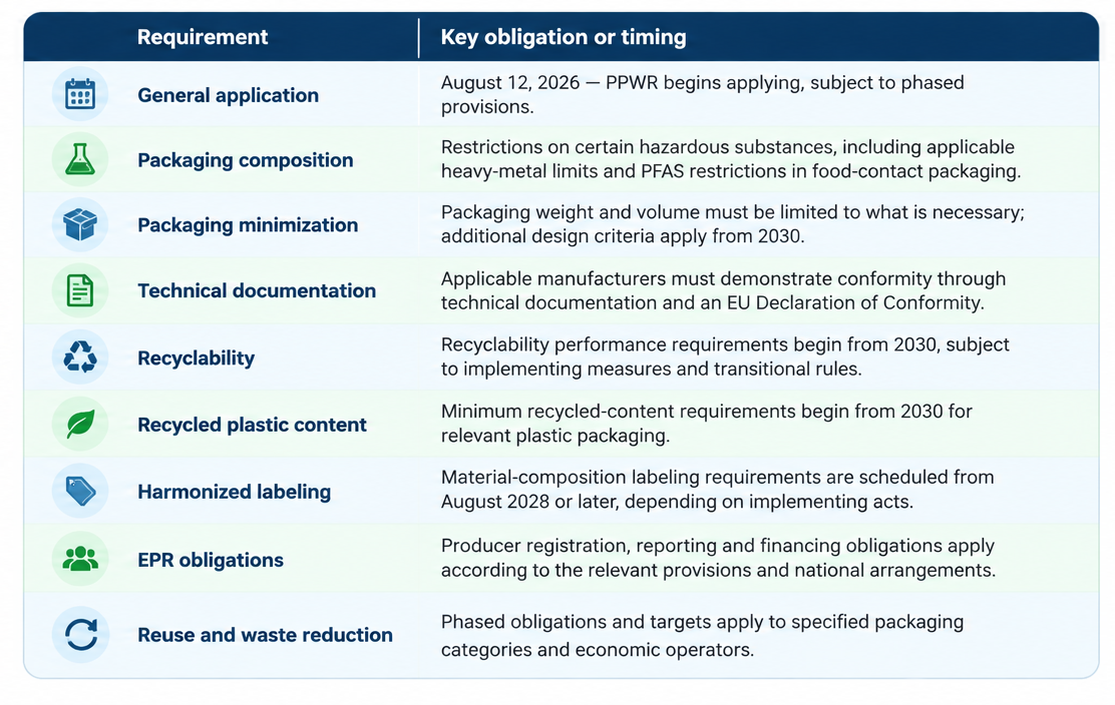
Summary of PPWR Requirements
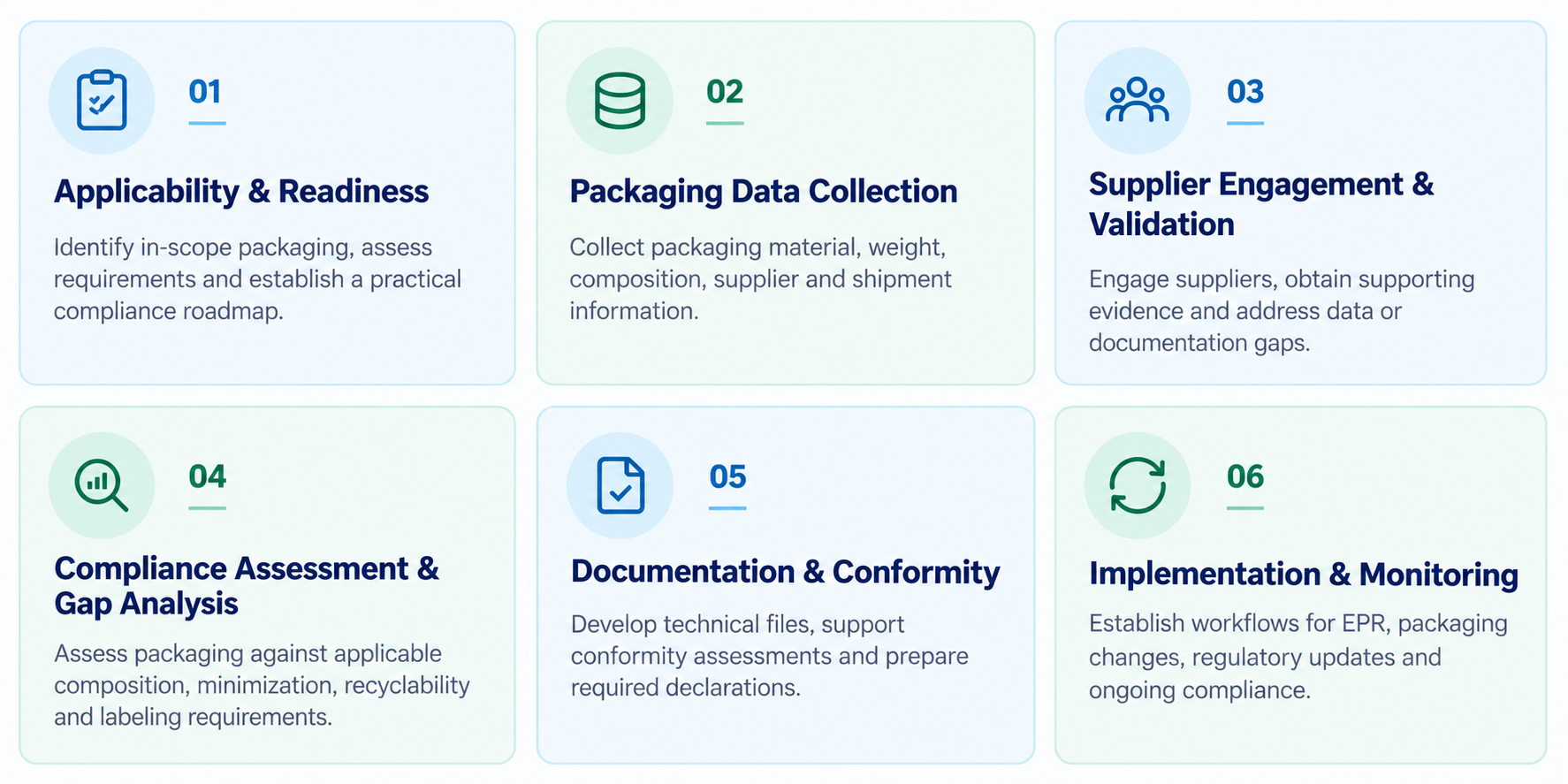
How TBG Can Support Your PPWR Compliance Process
TBG Compliance System
Streamlining PPWR Compliance Through Technology
From fragmented packaging information to centralized, actionable compliance data.
For multinational manufacturers, one of the most significant PPWR implementation challenges is collecting and managing accurate packaging information across products, facilities, suppliers and European markets.
Packaging data may be distributed across procurement systems, engineering specifications, warehouse records, supplier documents and logistics operations. Without a structured approach, companies can face difficulties identifying packaging components, validating material composition, determining packaging weights and preparing supporting compliance documentation.
TBG has developed a customizable PPWR data collection and management solution (dashboard app) designed to help companies organize packaging information and support practical compliance implementation.
Our solution can support:
Packaging inventories: Centralized records of packaging types, components, materials and configurations.
Data collection: Structured inputs for packaging weights, dimensions, composition and other required information.
Supplier engagement: Collection and tracking of packaging specifications and supporting documentation.
Compliance assessment: Identification of missing information and packaging requiring further technical review.
Documentation management: Organization of supporting evidence for technical files and conformity assessments.
Ongoing monitoring: Updates to packaging records as suppliers, materials, products and regulatory requirements change.
By combining regulatory expertise with practical data-management capabilities, TBG helps companies move from manual, fragmented compliance exercises toward more efficient and repeatable packaging management processes.

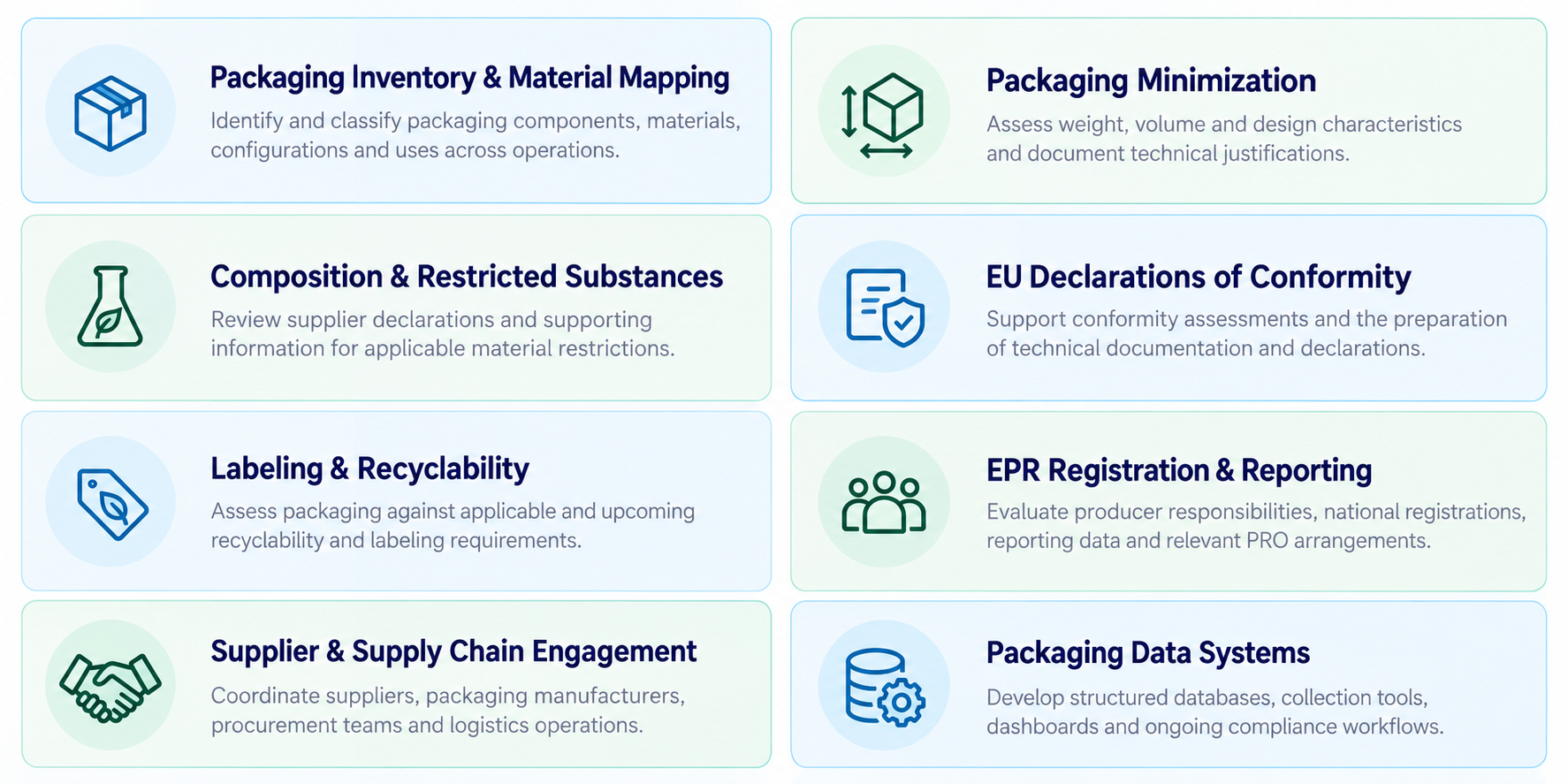
PPWR Compliance Capabilities
PPWR Compliance Capabilities
PPWR FAQ
1.Does PPWR apply to companies based outside the European Union?
Yes. Companies outside the EU may have obligations when they manufacture, supply or export packaging or packaged products for the EU market. The precise responsibilities depend on the company's role, the packaging involved and the relevant transaction structure.
TBG can assess the implications for U.S. and other non-EU manufacturers, including companies with European subsidiaries, distributors or direct customers.
2.Does PPWR cover industrial and transport packaging?
Yes. PPWR covers a broad range of packaging, including industrial and transport packaging such as wooden crates, pallets, corrugated cartons, plastic wrapping and protective materials.
Although certain requirements vary by packaging type and use, industrial packaging should not be assumed to be exempt.
3.What is an EU Declaration of Conformity under PPWR?
An EU Declaration of Conformity (DoC) is a formal declaration by the manufacturer that the packaging meets applicable PPWR requirements. It is supported by technical documentation and the relevant conformity assessment process.
TBG can help companies organize packaging information, identify supporting evidence, prepare technical documentation and develop conformity assessment and declaration workflows.
4.What packaging data should companies collect?
Companies should begin by identifying packaging components, material types, weights, dimensions, suppliers, intended uses and relevant markets.
Additional information may be necessary to demonstrate compliance with material restrictions, packaging minimization, recyclability, recycled-content and other applicable requirements.
TBG's PPWR data collection solution helps organize this information and identify gaps requiring further assessment.
5.Do companies need to register for EPR in every EU country?
EPR obligations depend on the company's role as a producer and the Member States in which packaging or packaged products are made available.
Companies may need to register with national authorities, participate in producer responsibility organizations, submit packaging data and finance packaging waste management.
TBG can help assess country-specific requirements and develop a coordinated EPR compliance approach.
6.Are packaging labels required under PPWR?
PPWR introduces harmonized labeling requirements, with implementation phased according to the relevant provisions and implementing acts.
Companies should review their packaging types, monitor the applicable labeling specifications and incorporate labeling requirements into packaging design and compliance planning.
7.Can TBG help companies that already have packaging databases?
Yes. TBG can review existing packaging inventories, supplier specifications and data-management systems, identify missing PPWR data fields and help adapt current databases to support compliance.
Where appropriate, our data collection solution can complement existing workflows rather than requiring companies to rebuild their entire packaging information infrastructure.
8.What should companies prioritize now?
Companies should prioritize applicability assessments, packaging inventories, supplier data collection, technical documentation, composition reviews and packaging minimization.
They should also establish a roadmap for later requirements, including recyclability, labeling, recycled content, reuse and EPR obligations.
Why Work With TBG on PPWR?
Regulatory expertise. Practical implementation. Technology-enabled compliance.
TBG supports global companies navigating complex sustainability and regulatory requirements across the United States, Europe and international markets.
Our PPWR approach integrates regulatory analysis, packaging data management, supplier engagement, operational implementation and compliance documentation.
We recognize that packaging compliance is not simply a legal or reporting exercise. It requires accurate data, effective coordination across business functions and systems that can accommodate changing packaging configurations, suppliers and regulatory requirements.
By combining sustainability consulting expertise with customizable data collection tools, TBG helps companies establish practical, scalable approaches to packaging compliance.
Our capabilities include:
Cross-border regulatory expertise — Understanding European requirements and their implications for international businesses.
Industrial and manufacturing experience — Addressing complex packaging portfolios, supply chains and operational environments.
Data-driven implementation — Building structured packaging inventories, collection processes and supporting documentation.
Technology-enabled solutions — Integrating customizable data collection applications and compliance workflows.
End-to-end support — From applicability and readiness assessments through implementation, documentation and ongoing monitoring.
Tackle PPWR with Confidence
Whether you're assessing PPWR applicability, collecting packaging information, preparing Declarations of Conformity, evaluating EPR obligations or developing an integrated compliance program, TBG can help.
Our team combines regulatory insight, operational expertise and practical data collection solutions to support compliance across complex international supply chains.