EUDR Compliance & Reporting: Requirements, deadlines and practical guidance for companies preparing for the EU Deforestation Regulation
What You Need to Know About EUDR
What is EUDR?
The EU Deforestation Regulation (EUDR), formally known as Regulation (EU) 2023/1115, is a legislative measure adopted by the European Union to combat global deforestation and forest degradation, particularly damage from the expansion of agricultural land tied to specific commodities. EUDR covers seven key commodities: cattle, cocoa, coffee, oil palm, rubber, soybeans, and wood, as well as products derived from these commodities, such as leather, chocolate, furniture, pulp and paper, printed books, and more. For more information, just click below to schedule a complimentary consultation with our sustainability/EUDR team for a complimentary consultation or send an email.
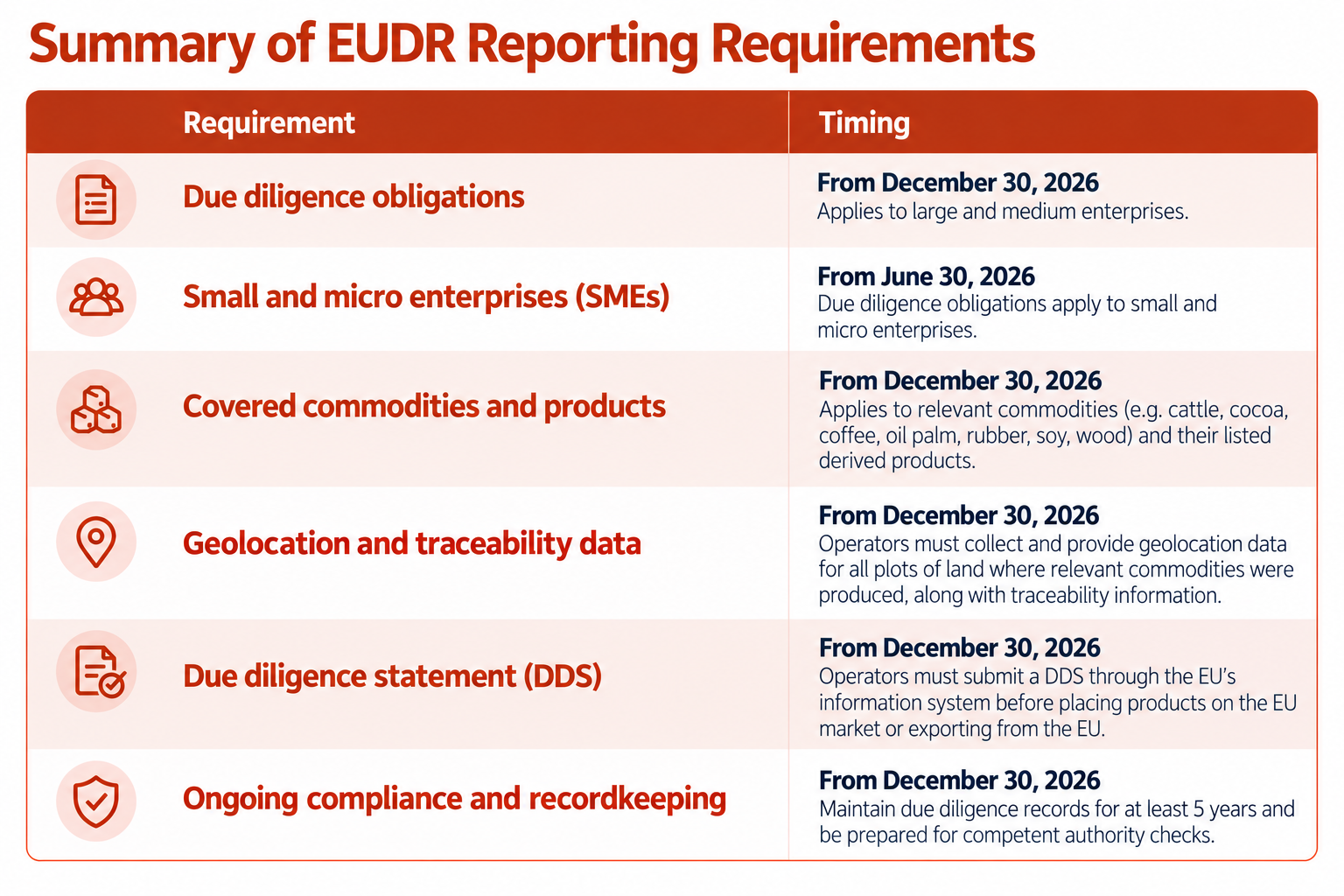
Reporting Schedule:
Not sure whether EUDR applies to your company?
EUDR applies to relevant products containing, made from, or produced using covered commodities—cattle, cocoa, coffee, oil palm, rubber, soy and wood—when those products are placed or made available on the EU market or exported from the EU. Applicability also depends on your company's role in the supply chain and the products covered by Annex I of the Regulation.
TBG can help assess your products, commodities, supply chains and company role to determine your EUDR obligations. Schedule a complimentary consultation via our Calendly or send us an email.
What are the EUDR timing considerations and key requirements?
Following the latest postponement, EUDR requirements apply from December 30, 2026 for companies other than most micro and small operators. Most micro and small operators have until June 30, 2027, although specific transitional rules apply, including for certain operators previously covered by the EU Timber Regulation.
Companies should use the remaining preparation period to determine applicability, map relevant products and supply chains, engage suppliers, collect required information and geolocation data, establish due-diligence and risk-management processes, and prepare for applicable reporting and submission requirements.
What are the EUDR due diligence and reporting requirements?
Under the revised EUDR framework, responsibility for submitting a Due Diligence Statement (DDS) generally rests with the first operator placing a relevant product on the EU market or exporting it. Downstream operators and traders are generally no longer required to submit separate DDS filings, although applicable traceability and recordkeeping obligations remain.
Where a DDS is required, companies must collect relevant product and supplier information, establish traceability, assess deforestation risks and implement mitigation measures where necessary. The DDS must be submitted through the EU's EUDR Information System before the relevant products are placed on the EU market or exported.
What next steps should we take to ensure EUDR compliance?
With the December 30, 2026 application date approaching, companies should move beyond preliminary assessments and begin operationalizing their EUDR compliance programs. This includes confirming which products and supply chains are in scope, engaging suppliers, addressing data and traceability gaps, establishing risk-assessment and mitigation procedures, and preparing systems and documentation for applicable due-diligence requirements.
TBG can support the full compliance process—from scoping and systems setup through supplier engagement, data collection and traceability, risk assessment and mitigation, verification, due diligence and ongoing monitoring. Get in touch with TBG's Sustainability Team today or choose a convenient meeting time via our Calendly.
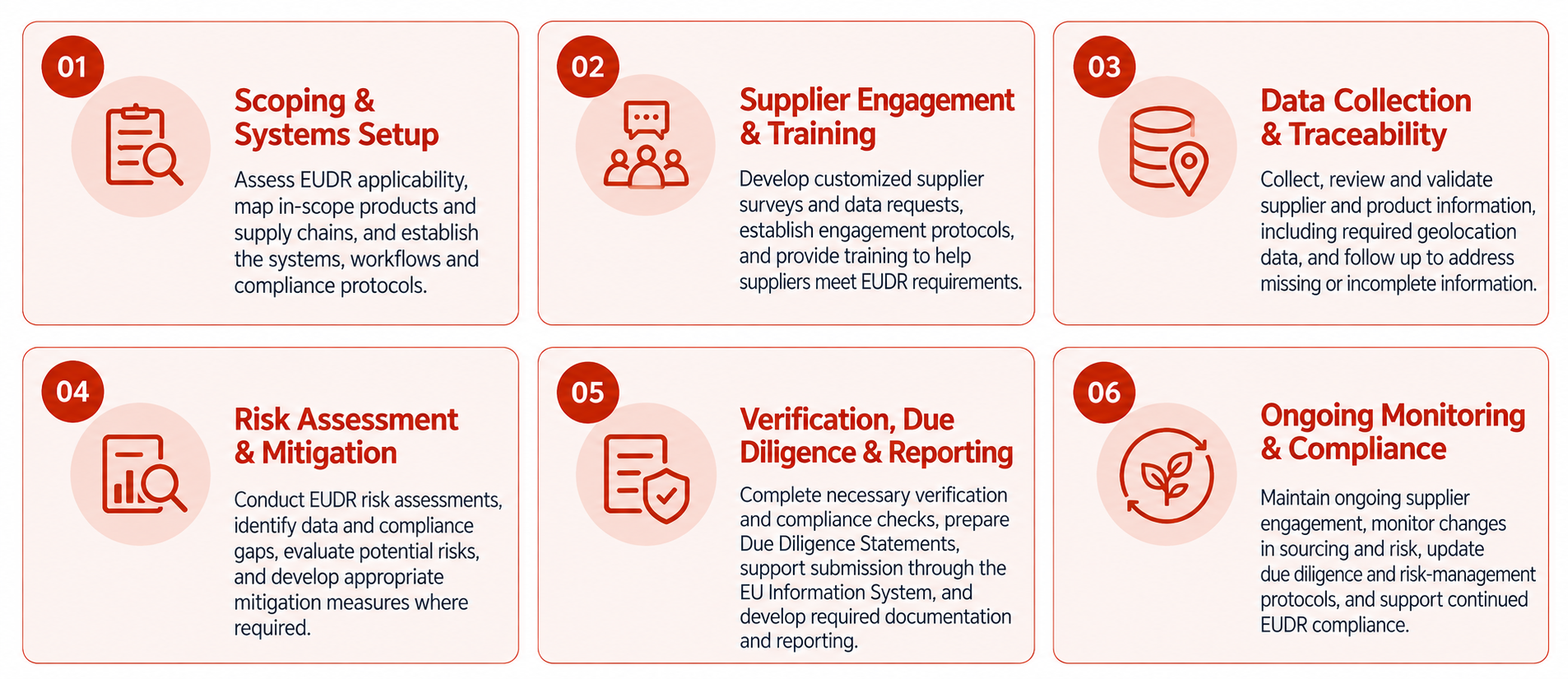
Key Steps in the EUDR Compliance Process
1. Scoping and Systems Setup
Assess EUDR applicability and establish the systems, workflows and compliance protocols needed to manage supplier engagement, data collection, due diligence and risk management.
2. Supplier Engagement & Training
Develop customized supplier surveys and data requests, establish engagement protocols, and provide training to help suppliers understand and meet EUDR information requirements.
3. Data Collection & Traceability
Collect, review and validate supplier and product information, including required traceability and geolocation data, and follow up to address missing or incomplete information.
4. Risk Assessment & Mitigation
Conduct EUDR risk assessments, identify data and compliance gaps, evaluate potential risks, and develop appropriate mitigation measures where required.
5. Ongoing Monitoring & Compliance
Maintain ongoing supplier engagement, monitor changes in sourcing and risk, update due diligence and risk-management protocols, and support continued EUDR compliance.
EUDR FAQ
1.What is EUDR?
The EU Deforestation Regulation (EUDR), formally known as Regulation (EU) 2023/1115, is a legislative measure adopted by the European Union to combat global deforestation and forest degradation, particularly damage from the expansion of agricultural land tied to specific commodities. EUDR covers seven key commodities: cattle, cocoa, coffee, oil palm, rubber, soybeans, and wood, as well as products derived from these commodities, such as leather, chocolate, furniture, pulp and paper, printed books, and more. For more information, just send an email to our EUDR team for a free background briefing/consultation.
2. What has changed in terms of the timeline/deadline?
EUDR has been the subject to a number of adjustments since the simplification process this Spring and the September 23rd notification from Environment Commissioner Jessika Roswall. As of November 26th, 2025, the EU Parliament has voted in favor of a uniform one-year delay (to December 30, 2026) across the board for all companies regardless of size. A final vote is due during December 15-18 in order to formalize the proposal as a law. Check back here for updates. In the meantime, scroll below to question#5 or send an email for more information.
3. What are the latest EUDR regulatory updates and product-scope changes?
The EU has introduced several simplification measures to reduce administrative burdens, clarify compliance responsibilities and refine the products covered by the EU Deforestation Regulation (EUDR).
Following the December 2025 legislative amendments and the adoption of Commission Delegated Regulation (EU) 2026/2102, which entered into force on September 18, 2026, the key updates include:
Simplified compliance obligations: Due diligence requirements have been streamlined, with reduced administrative responsibilities for downstream operators and traders and simplified procedures for eligible micro and small primary operators.
Products removed from scope: Certain cattle hides, skins and leather products; retreaded tires; soybeans for sowing; conveyor and transmission belts; certain vulcanized rubber articles; and motor vehicle and aircraft seats have been excluded.
New products added to scope: Soluble coffee, frozen cattle tongues and certain palm oil derivatives, including specified soap and oleochemical products, have been added. These newly covered products become subject to EUDR requirements on December 30, 2027.
Additional exemptions and clarifications: The updated framework clarifies the treatment of certain samples, testing materials, waste, second-hand goods and packaging.
Improved digital compliance systems: The European Commission has updated the EUDR Information System to support simplified declarations, traceability and automated data exchange.
The EU's 2026 simplification review has been completed, providing greater clarity on the regulatory framework ahead of the main compliance deadlines.
4.What does this mean for companies?
Businesses should reassess their product classifications against the revised EUDR scope, confirm their applicable compliance deadlines and update their supplier engagement, traceability and due diligence processes accordingly.
5.What should companies do next?
Companies should confirm whether their products fall within the revised EUDR scope, determine their obligations based on their position in the supply chain, and prepare the necessary supplier information, traceability data and due diligence procedures ahead of the applicable compliance deadlines.
TBG supports companies in translating these requirements into practical, technology-enabled compliance programs.
6. What are the EUDR obligations and requirements?
EUDR covers all relevant, in-scope products/goods derived from the seven key commodities. More specifically, companies (operators) that import to, place on, make available on or export from the EU market must address a number of key requirements:
Deforestation-Free — Companies/operators must ensure and certify that their products are deforestation-free and originate from land that was not deforested after December 31, 2020. They must also comply with the laws in the country where they were produced.
Due Diligence — Companies/operators must conduct due diligence to ensure that the production of commodities complies with the laws of the country of origin. They must submit due diligence statements (to the online registry) based on a robust risk assessment process.
Traceability — Companies/operators must collect information, documents, and data proving that the product is deforestation-free and legal, such as geolocation coordinates, quantity, country of production, etc.
7. What steps does my company need to take to get started on the EUDR journey?
The TBG Purpose/EUDR team works with companies at all stages of the EUDR journey. The first step you can take is to conduct the necessary training of internal and external stakeholders to ensure complete awareness. After training, you should undertake a scoping exercise, which will enable you to determine which products/parts to include in the EUDR data-gathering process. As part of our scope of work, the TBG Purpose/EUDR team has worked with various corporations to provide the necessary guidance and training, including live training sessions via Zoom/Teams. Just send an email, and let’s get to work.
8. What penalties will companies face if they do not comply with the EUDR?
Sanctions for non-compliance (fines, confiscations, suspension) will be enforced by requiring checks on a percentage of shipments based on the risk level of deforestation associated with the country of origin (high-standard-low). So, for example, shipments containing parts/products originating from a “high-risk” country (Russia, Belarus, North Korea, Myanmar) may be subjected to fines, confiscation, suspension, and exclusion from public funding or contracts. EU authorities may impose potential penalties of up to 4% on a sanctioned company’s EU turnover.
9. Has the EUDR deadline changed and why did it change?
The November 26th EU Parliament plenary adopted a uniform one-year delay for all companies instead of the December 30th, 2025 deadline for large operators (entities that are responsible for placing or making available products in the EU marketplace), and 2026 deadline micro and small enterprises.This latest development follows the new proposals introduced in September and October (see immediately below), and the demand by the EU Council (Danish Presidency) to adopt a full one-year delay. Some key points to keep in mind:
For micro- and small enterprises, the six-month grace period may be implemented in January-June, 2027. As the EU noted in October, a grace period would “allow economic operators to start complying with their obligations in line with the entry into application, while providing them with a grace period to adapt to the legislative changes.”
It is possible that downstream small and medium operators and traders may not be required to submit due diligence statements. Only one submission in the IT system will be required for the entire supply chain. In other words, the operator that places the product (or makes it available) in the market is responsible for reporting obligations.
The latest proposal must be formallized via a final vote on which is expected during December 15-18.
10. What Should Companies/Operators Do?
The EUDR saga can seem confusing so it is important to get the right guidance and support. We strongly recommend an EUDR Check-Up to determine your overall progress and obligations. This is a free service from TBG’s EUDR team that enables operators (of all sizes/categories) to quickly determine overall compliance and obligations ahead of the key deadlines.
11. How does TBG help companies address their EUDR needs?
TBG works closely with global corporations and SMEs/SMBs across the EUDR spectrum. Our services include supply chain engagement (customized surveys and data collection), research and analysis, due diligence statements, regulatory support, risk management, strategic advisory support, and training for internal and external stakeholders. We work closely with clients to develop their EUDR response systems, customized supplier surveys for due diligence, supplier tracking tools, and risk management frameworks.
12. Are there any changes to EUDR as a result of the EU Omnibus Simplification package?
Yes. While EUDR was not initially included in the simplification package, EUDR authorities introduced some simplification measures on April 14th, 2025. These measures focus more on reducing administrative burdens e.g. limiting the number of Due Diligence Statements. Here are the key changes per the new guidance. NOTE: Many changes listed here maybe further redefined following the pending November 26th vote.
Large companies can reuse existing due diligence statements when goods, previously on the EU market, are reimported. This means that less information needs to be submitted in the IT system;
"An authorised representative can now submit a due diligence statement on behalf of members of company groups;
Companies will be allowed to submit due diligence statements annually instead of for every shipment or batch placed on the EU market;
Clarification of ‘ascertaining' that due diligence has been carried out, so that large companies downstream benefit from simplified obligations (a minimal legal obligation of collecting reference numbers of Due Diligence Statement (DDS) from their suppliers and using those references for their own DDS submissions now applies)
13. Are there any changes to EUDR as a result of the April simplification review?
Yes. On May 4th, 2026, the European Commission published the results of the EUDR (EU Deforestation Regulation) Simplification Review and provided a number of key updates covering the overall legal scope, reduced burden for downstream operators and small operators, proposed changes to exclude and include certain commodities (ranging from leather to coffee to palm oil derivatives) and proposed new guidance for agriculture chains. The draft Delegated Act proposing changes to Annex is now open for public feedback and the comment period will close on June 1st. For detailed insights on the Simplification Review and a customized briefing on EUDR, get in touch with TBG’s EUDR Team via <info@bassiounigroup.com>.
14. What is the country benchmarking system?
On May 22, 2025, the EU adopted the Country Benchmarking System, which is designed to guide the overall compliance process. According to this new guidance, EU Member States and Competent Authorities must apply the following protocol for their annual compliance checks: 1% for low-risk countries, 3% for standard risk countries and 9% for high-risk countries. A “no-risk” proposal was considered and rejected in 2025 and again in May, 2026. Only four countries (Russia, Belarus, North Korea, Myanmar) have been classified as high-risk with most countries designated as “standard risk”. This means that companies responding to EUDR must fully document supplier sourcing (based on the EUDR requirements) and enhance their risk management frameworks to ensure full compliance. To find out how the Country Benchmarking System applies to your company, just send an email to our EUDR team.
15. How Does the EU classify companies?
“Operators” refers to large corporations/multinationals that are responsible for “placing products on (or making those products available in) the EU marketplace” and that sit above the revenue and employee threshold determined for SMEs. Conversely, “small” operators refers to SMEs and small companies based on the the following (staff and personnel) EU guideline:
medium companies (defined as those <250 employees and turnover of <€50 million),
small companies (defined as those with <50 employees and a turnover of <€10 million)
micro-enterprises (defined as those with <10 employees and a turnover of <€2million)
Interested in TBG’s EUDR solution? Click below.
Get EUDR Support Now
The EUDR/December 30th deadline Is fast approaching. TBG can help you assess your progress, identify gaps and develop a practical path to compliance.