Corporate Sustainability Consulting Solutions for a Changing Global Economy: We help global companies manage sustainability risks, meet evolving regulatory requirements, strengthen reporting and turn sustainability priorities into practical action.
Corporate Sustainability Solutions & Services
A division of The Bassiouni Group, TBG Purpose is a leading corporate sustainability & ESG solutions partner for global corporations (Fortune 500/1000), SMBs/SMEs, institutions, and governmental agencies. We provide an integrated set of solutions to enable organizations to meet their sustainability objectives in line with global reporting standards & frameworks (e.g. TCFD, IFRS S2) as well as regulations such as the EUDR, CBAM, CSRD & CSDDD in Europe and SB 261, SB 253 and SB 54 in California. From Materiality Assessments to Climate Risk Assessments to Life Cycle Assessments to Program/Strategy Development to Sustainability Reports/Report Cards, we cover all of your needs. Visit our dedicated pages for:
We take a customized approach to each client/project. We leverage global and local knowledge by engaging our multicultural team of sustainability experts based in five continents. This core team is supported by TBG’s Project Management Team as well as specialists drawn from TBG’s global consultancy network, which is comprised of 1,000+ experts in 150+ countries. Furthermore, we work with a broad range of strategic partners covering supply chain analytics, accreditation & certification, and training & education.
Click below to schedule a complimentary initial consultation so we can better understand your needs and develop the right solution.

TBG works closely with Fortune 500/1000 companies and dynamic SMEs/SMBs at each step of the sustainability journey. We cover a wide range of sectors from technology to manufacturing to healthcare/medtech.
Supporting Fortune 1000, SMEs & global organizations.
Powered by 1000+ experts across 150 countries
Cross-sectoral experience & expertise
U.S. & EU regulatory experience
-
![Illustration depicting EUDR compliance with trees, a document, and a circular arrow around a checkmark.]()
EU Deforestation Regulation (EUDR)
Are you ready to meet the EUDR deadline in 2026? Are you fully compliant? TBG supports global corporations with an integrated supplier engagement, risk management, training and consulting solution. Click below to access our EUDR team & solution.
-
![Illustration of climate risk assessment with solar panels, factory, globe, light bulb, and hands holding Earth, under the text 'Climate Risk Assessment'.]()
Climate Risk Assessment & CVaR
A Climate Risk Assessment enables you to determine how physical and transition risks (policy, regulatory, tech, market changes) can materially impact your business & financial performance & asset valuation. We will tackle your CRA in line with SBTi, CDP, TCFD/IFRS S2, and key regulations.
-
![Illustration of two people at a desk with plants and multimedia elements, with the text 'Sustainability Reporting' at the top.]()
Sustainability Reporting
Sustainability reporting can be time-consuming and complicated. IFRS S2? TCFD? WEF Common Metrics? We will help you to develop credible, quantifiable and impactful sustainability reports that accurately reflect your progress and that are in line with global standards and frameworks.
-
![Illustration with text 'ESG Strategy & Program Development', featuring two people with a large light bulb and decorative plants.]()
Strategy & Program Development
How does your corporate sustainability strategy and program measure up? Are your goals aligned with your business objectives? We will work with you to develop a program that effectively addresses internal & external stakeholders, regulators and governmental authorities.
-
![Illustration of four people interacting with a large smartphone displaying emissions data, labeled "Emissions Reporting."]()
Emissions Reporting
Where do you stand when it comes to emissions? What systems and tools are in place? We will help you to track, measure, and report your Scope 1, Scope 2 and Scope 3 emissions in line with your industry requirements, government regulations and global standards.
-
![Illustration of three people interacting with bar and pie charts, representing a materiality assessment concept. The text "Materiality Assessment" is at the top, and the charts are highlighted with upward trends and data segments.]()
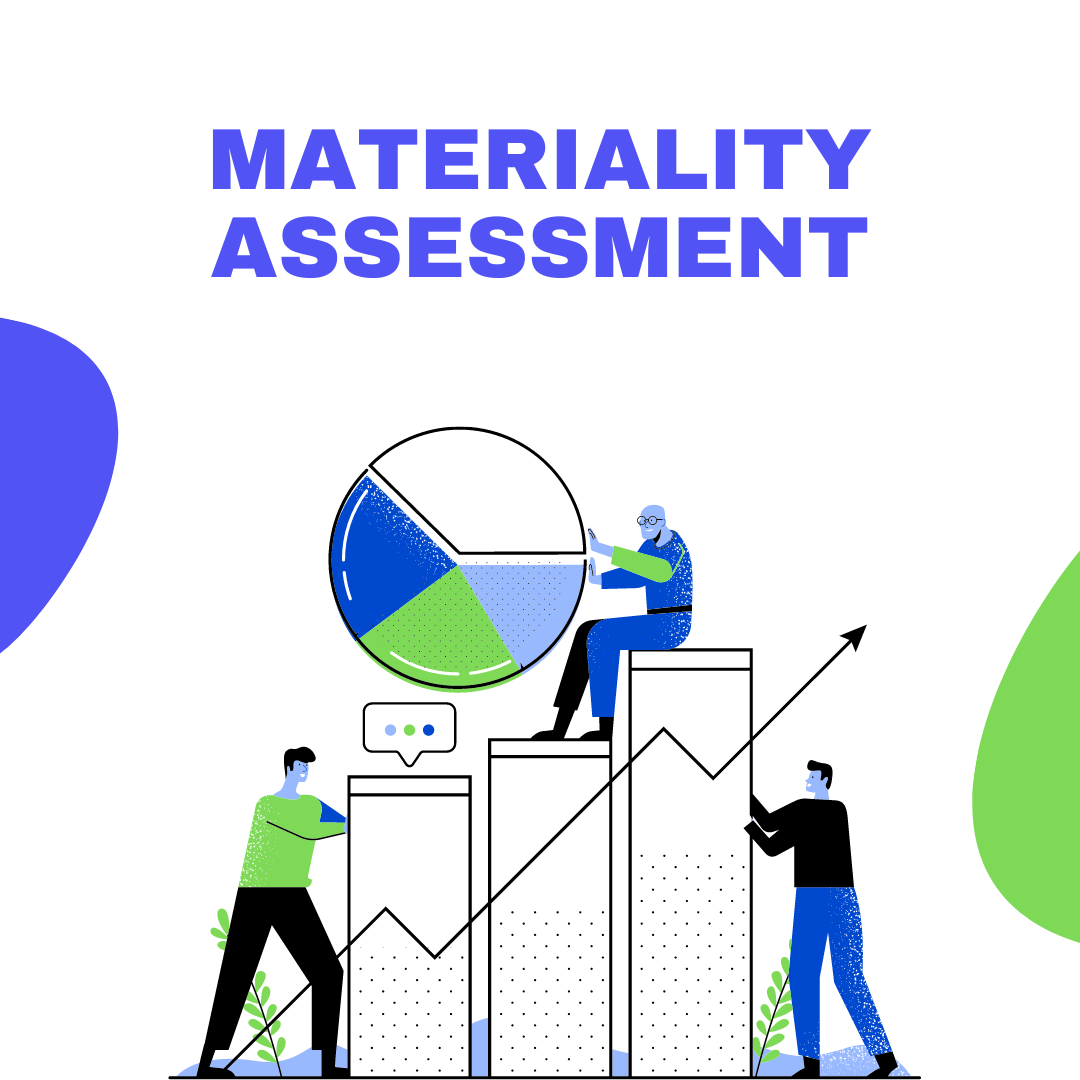
Materiality Assessment
A Materiality Assessment is a foundational exercise that forms the backbone of sustainability reporting. We will engage your internal and external stakeholders to identify the most “material” issues and determine what should be reported.
-
![Illustration titled "Sustainability Report Card" with three individuals and a green chart showing upward trend, surrounded by abstract green and blue shapes.]()
Sustainability Report Card
Where are you on your sustainability journey? Where are the key gaps? You need to track your progress. We will develop a Sustainability Report Card, which captures your progress across key metrics and focal areas so that you can enhance your sustainability journey.
-
![Illustration of two people working at a tech control room with multiple screens displaying data and graphs, titled 'Monitoring & Evaluation'.]()
Monitoring & Evaluation
Monitoring & Evaluation (M&E) is a results-based management approach that enables organizations to continuously assess and improve key programs and overall performance. Our M&E Practice Group’s track record covers 60+ countries.
-
![Illustration highlighting supply chain sustainability with a person pointing at a world map. The map shows icons for transportation and logistics, including a truck, plane, ship, store, and factory. Boxes are stacked in the foreground.]()
Supply Chain Sustainability
Businesses face in an increasingly disruptive global economy. By leveraging our global network, we can help you identify supply chain risks (from sourcing to geopolitical) , transform challenges into opportunities and enhance supply chain sustainability and resilience.
-
![Illustration with "Regulatory Guidance" text, showing a person presenting data on a screen to a seated group.]()
Regulatory Support
Are you fully compliant with PPWR, EUDR, CBAM, CSRD and CSDDD? Are you ready for California’s new climate laws (SB 261, SB 253, SB 54) as well as Oregon, Maine and New York? Whether you are an American or European or British company, our team will guide and support you.
-
![Illustration of a person at a desk with an open book, looking at a computer screen showing a grid layout, with 'Gap Assessment' text above.]()
Gap Assessment
A Gap Assessment is an important exercise that can help you to start, adjust or accelerate your sustainability journey and overall compliance. Our team will assess your existing efforts, analyze performance, highlight risks, and identify key areas for improvement & action.
-
![]()
Data Collection
Reliable, high-quality data is the cornerstone of effective reporting and compliance. We develop customized data collection systems to capture critical data across your operations and supply chain. The result is a scalable data that supports reporting, disclosure and compliance needs.
-
![]()
Carbon Accounting/LCA
We quantify your environmental footprint through comprehensive carbon accounting and life cycle assessments (LCAs) across your value chain. From Scope 1, 2 and 3 emissions to product-level LCAs, we generate insights that meet regulatory and reporting requirements.




Request a Free 30min Consultation
Let’s talk. Schedule a FREE 30min consultation by clicking here or filling the form below. We will use the call to get a better understanding of your Sustainability/ESG needs. Whether you need comprehensive support (e.g. Sustainability Program) or a focused solution (e.g. Annual Sustainability Report, Emissions Inventory), the TBG Purpose team will be able to help.
How We Can Help You
We provide a wide range of corporate sustainability & ESG solutions for organizations of all sizes. Here are some of the ways we can help you:
Starting/Accelerating the Sustainability Journey — We meet you where you are in your sustainability journey and customize our efforts so that you can achieve your objectives in an efficient and effective manner.
Integrated Approach — We take a holistic approach to sustainability and provide an integrated suite of services (from data collection to reporting to strategy development) customized to each client.
Customized Solutions — Sustainability is not a “one-size-fits-all” proposition. That’s why we take a customized approach to each client and provide you with a specific set of solutions tailored to your needs.
Providing Timely Support & Resources — We view ourselves as an extension of your sustainability department. We enhance your productivity and efficiency by tackling time-consuming reporting and compliance-related tasks while managing key projects.
Knowledge Base — It is vitally important to keep up with the rapid developments across the sustainability and regulatory spectrum. We continuously monitor key developments and leverage internal insights and external knowledge through our partners.
We have a singular mission and promise: We will help you to harness sustainability and innovation to generate revenue and impact while accelerating the journey to Net Zero.
Sustainability & ESG News
-
![Mist covered dark green forest, symbolizing environmental theme.]()
EUDR
Are you ready to meet the EU Deforestation Regulation (EUDR) deadline in 2026? The EUDR is designed to combat global deforestation and governs 7 key commodities: cattle, cocoa, coffee, oil palm, rubber, soy, and wood. Companies operating in the EU must be compliant by Dec. 30, 2026. Get in touch with our EUDR team to ensure full compliance.
-
![Hands holding papers with colorful graphs and charts, alongside a Samsung tablet displaying a home screen, on a wooden desk with markers and sticky notes.]()
CDP 2026
CDP scores will be published during the week of November 30th. It is critically important to conduct a gap analysis in December to identify key areas for improvement while preparing for the 2027 cycle. Improving your CDP score requires a diligent approach and continuous adjustments based on a comprehensive gap analysis. Click below.
-
![European Union flags waving in the wind outside a building]()
EU Regulations
Are you fully compliant with EUDR, PPWR, CBAM, CSRD and CSDDD? Briefed on the Simplification Omnibus? Whether or not you are subject to the EU regulations is dependent upon a number of factors. It is important to determine your exposure and develop an action plan. Click below for more information, and get the guidance you need.
-
![Gov. Gavin Newsom speaking passionately at podium with "The Governor of the State of California" seal, wearing a white shirt, in an outdoor setting.]()
CA (SB 253, 261, 54)
California’s comprehensive set of climate laws (SB 261, SB 253, SB 54) cover emissions (scopes 1-3) reporting, climate risk and plastics. Are you in or out of scope? Are you fully compliant? What is the status of your (SB 261, SB 253, SB 54) compliance program? What are the key gaps? Click below for more information.




Why Work with Us?
We understand that there are numerous sustainability consultants to choose from, and we encourage prospective clients to explore the competitive landscape. We are confident in our capabilities and track record with Fortune 1000 clientele. We do not provide “one-size-fits-all” services — we work closely with you at every step of your sustainability journey and deliver a customized solution.
SDG Roots & 2030 Agenda — As a company with a strong UN track record and UN roots, we have a deep understanding of the Sustainable Development Goals (SDGs). We are uniquely committed to the 2030 Agenda.
Global Team & Experience — Our sustainability team spans five continents. So, we can leverage both global and local knowledge. This core team is backed by TBG’s 1,000+ experts across 150+ countries and by TBG’s project management team.
Talent + Technology — We combine our human talent with the leading AI, data management, and supply chain analysis tools from leading technology partners to provide cutting-edge solutions.
Best Practices — TBG sits at the nexus of business, politics, and economics, and we work across the public and private sectors. So, we are uniquely positioned to implement "hybrid" best practices while remaining fully compliant with global reporting standards and frameworks.
Ethical Commitment — We hold ourselves to high professional and ethical standards and work with clients committed to credible, measurable progress on sustainability.
CSR Leaders — TBG co-founded CSR Leaders (on Linkedin) in 2012 to create a global community of sustainability professionals and encourage the sharing of knowledge and best practices. Today, the group includes over 34,000 professionals (executives/practitioners, students, supporters) worldwide, covering numerous industries and sectors.