
Climate Risk Assessment & Climate Value-at-Risk (CVaR): Understand Climate Exposure. Quantify Financial Risk. Build Long-Term Resilience.
Leading Climate Risk & CVaR Solutions
TBG helps companies identify, assess and quantify the physical and transition risks associated with climate change across their global operations, assets and supply chains.
Combining advanced climate modeling, internationally recognized scenarios and technology-enabled analysis, we provide forward-looking assessments of climate-related financial and operational exposure, including Climate Value-at-Risk (CVaR).
Our solutions support corporate risk management, strategic planning, investment decisions, resilience planning and alignment with leading sustainability reporting frameworks.
For more information, just click below to schedule a complimentary consultation with our sustainability team or send an email.
What You Need to Know About Climate Risk Assessment
What is a climate risk assessment?
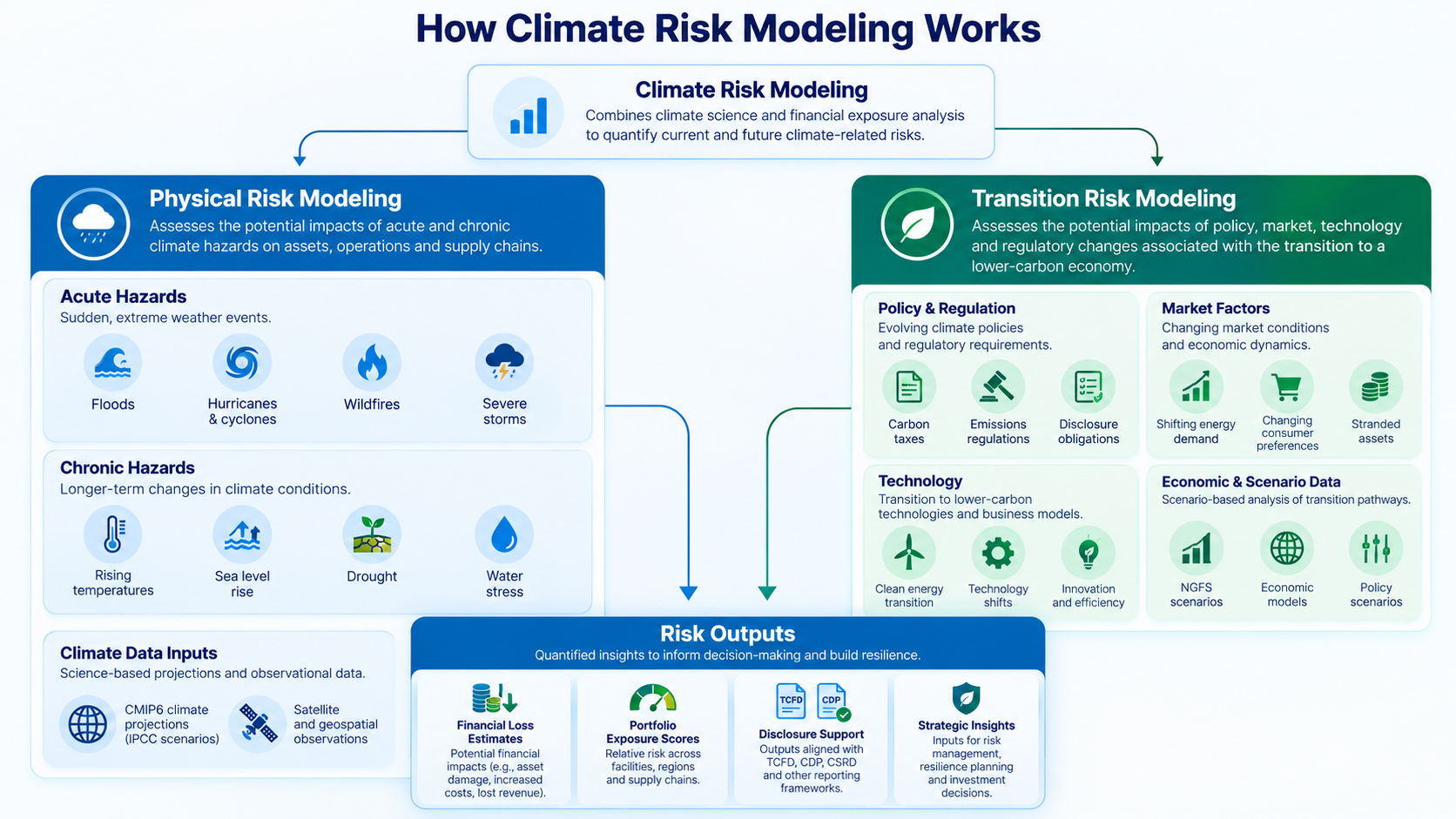
A climate risk assessment evaluates how changing climate conditions and the transition to a lower-carbon economy may affect an organization's operations, assets, financial performance and supply chains.
Climate-related risks can develop over different time horizons and affect companies through physical damage, business interruption, operating costs, regulatory requirements, market developments and other financial or operational channels.
TBG helps companies move beyond high-level risk identification to develop structured, forward-looking assessments that identify potential vulnerabilities, evaluate material risks and support informed business decisions.
Our assessments can cover individual facilities, regional operations, global asset portfolios and relevant upstream supply chains.
What is the difference between physical and transition climate risks?
Climate-related risks are generally grouped into two major categories.
Physical Climate Risks
Physical risks arise from changing weather patterns, extreme events and longer-term changes in climate conditions.
These include:
Extreme weather: Hurricanes, tropical cyclones, severe storms and high winds.
Flooding: Coastal, riverine and precipitation-related flooding.
Extreme heat: Heatwaves, rising temperatures and associated impacts on facilities and equipment.
Water stress: Drought, changing precipitation patterns and water availability.
Wildfires: Increasing exposure to fire hazards and associated disruption.
Chronic climate changes: Long-term shifts in temperature, precipitation and sea level.
These risks can affect facilities, equipment, infrastructure, employee safety, insurance exposure, business continuity and supply-chain operations.
Transition Climate Risks
Transition risks arise from policy, regulatory, technological and market changes associated with the shift toward a lower-carbon economy.
These include:
Policy and regulation: New climate regulations, emissions standards and disclosure obligations.
Carbon pricing: Carbon taxes, emissions trading systems and other carbon-cost mechanisms.
Technology shifts: Changes in production technologies, energy systems and industrial processes.
Market developments: Changing customer preferences, energy costs, demand patterns and competitive conditions.
Reputational considerations: Stakeholder expectations concerning climate strategy and corporate performance.
TBG evaluates physical and transition risks together to help companies understand how different climate scenarios may affect their long-term business performance.

What is Climate Value-at-Risk (CVaR)?
Climate Value-at-Risk (CVaR) translates potential climate-related impacts into financial metrics, helping companies understand the economic consequences of climate exposure.
Depending on the assessment methodology, CVaR can estimate potential climate-related losses, additional capital expenditure, asset impacts or other financial effects over defined future periods.
For physical climate risk assessments, this may include projected damage to buildings and critical equipment, increased maintenance or replacement costs, and losses associated with extreme weather events.
TBG helps companies assess and interpret climate-related financial exposure, identify higher-risk assets and develop actionable recommendations for risk management and resilience planning.
CVaR assessments can support:
Financial planning and capital allocation.
Asset and portfolio risk management.
Insurance and risk mitigation discussions.
Business continuity and resilience planning.
Climate-related financial disclosures.
Investment prioritization and long-term strategic planning.
How does TBG assess future climate risks?
TBG uses recognized climate scenarios, analytical methodologies and technology-enabled assessment tools to evaluate how physical and transition risks may evolve over time.
Physical Risk Scenario Analysis
Physical risk assessments can draw on climate projections and pathways assessed by the Intergovernmental Panel on Climate Change (IPCC), including scenarios representing different future greenhouse gas emissions and warming outcomes.
These projections help assess changes in climate hazards such as temperature, precipitation, flooding, extreme weather and other relevant physical risks.
Transition Risk Scenario Analysis
Transition risk assessments can draw on scenarios developed by the Network for Greening the Financial System (NGFS), including pathways reflecting different combinations of climate policy, technological change, energy transition and economic outcomes.
These scenarios help companies explore how policy developments, carbon pricing, market changes and transition pathways could affect their operations and financial performance.
Forward-Looking Time Horizons
Depending on the assessment, TBG can evaluate climate risks across near-, medium- and long-term horizons, including projections extending to 2100 where supported by the selected climate models and datasets.
Assessments can incorporate multiple climate scenarios and time horizons to help companies understand potential outcomes under different future conditions.
Climate scenario analysis is not a prediction of future events. It provides a structured way to evaluate plausible climate-related risks and uncertainties.
Why should companies conduct a climate risk assessment?
Climate risk assessments help companies understand how changing environmental conditions and economic transitions may affect their operations and long-term financial performance.
A comprehensive assessment can help organizations:
Identify facilities, assets and suppliers exposed to climate hazards.
Quantify potential financial impacts through CVaR and related analyses.
Assess business continuity and supply-chain vulnerabilities.
Evaluate climate risks under multiple future scenarios.
Prioritize adaptation and resilience investments.
Integrate climate considerations into enterprise risk management.
Strengthen climate-related reporting and disclosures.
Support long-term strategic planning and capital allocation.
By connecting climate science with financial and operational analysis, TBG helps organizations translate climate-related uncertainty into actionable risk management insights.
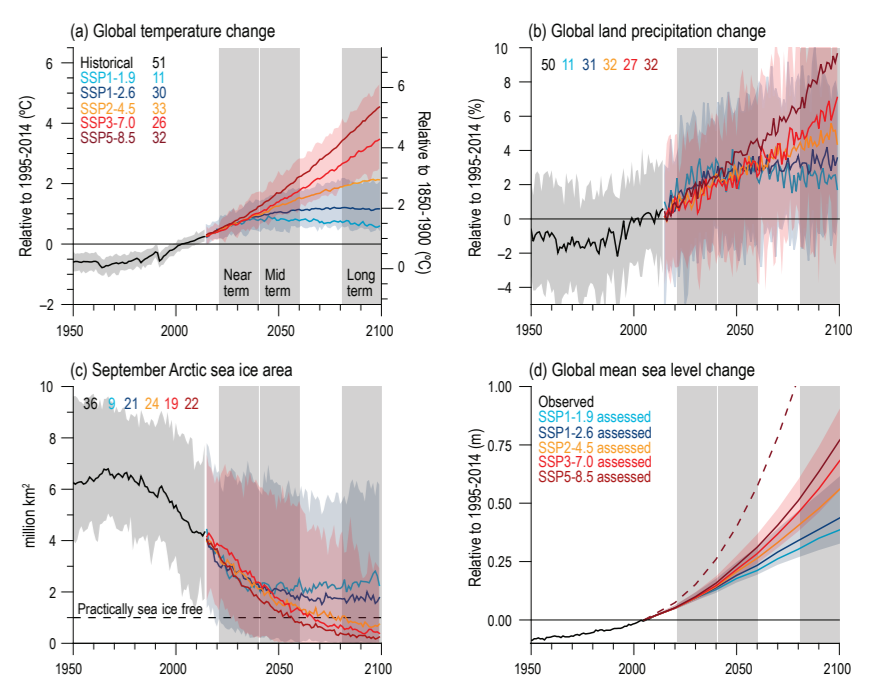
IPCC (Future Global Climate: Scenario-based Projections and Near-term Information): “This figure outlines selected global climate change indicators from CMIP6 historical and scenario simulations. It details annual or September averages for surface air temperature, land precipitation, Arctic sea ice area, and global mean sea level (GMSL) change under various shared socioeconomic pathways (such as SSP1-2.6, SSP3-7.0, and SSP5-8.5). The figure includes multi-model means, uncertainty ranges, and specific high-end low-confidence outcomes like a 1.7 m GMSL rise by 2100 under SSP5-8.5.”
How TBG Can Support Your Climate Risk Assessment Process
01 — Scoping & Climate Risk Readiness
Define assessment objectives, identify relevant facilities, assets and supply chains, establish geographic coverage and select appropriate climate scenarios and time horizons.
02 — Climate Data & Exposure Mapping
Collect asset and location data, evaluate geographic exposure and map relevant physical climate hazards and transition risk drivers.
03 — Physical & Transition Risk Assessment
Assess acute and chronic physical climate risks alongside policy, carbon pricing, technology and market-related transition risks using recognized scenarios and analytical methodologies.
04 — Climate Value-at-Risk (CVaR) Analysis
Quantify potential financial impacts for applicable assets and risk categories, identify material exposures and evaluate projected impacts over defined future periods.
05 — Reporting & Framework Alignment
Translate assessment findings into climate-related risk disclosures, supporting documentation and reporting aligned with applicable standards and regulatory frameworks.
06 — Risk Mitigation & Resilience Planning
Prioritize material risks, identify adaptation and mitigation opportunities, and develop recommendations to strengthen business continuity, asset resilience and long-term strategic planning.
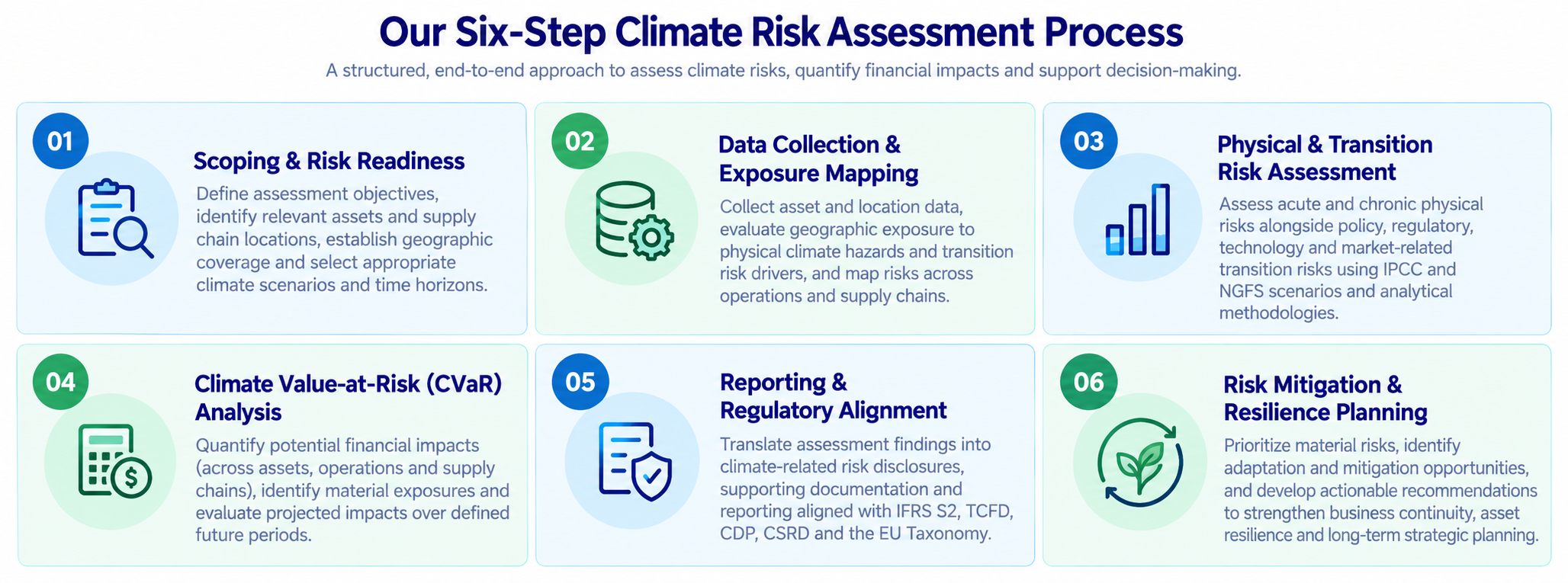
TBG’s six-step climate risk assessment process.
Climate Risk Assessment Capabilities
Physical Climate Risk Assessment
Evaluate exposure to acute and chronic physical climate hazards, including flooding, extreme heat, storms, wildfires, water stress and longer-term changes in climate conditions.
Transition Climate Risk Assessment
Assess risks arising from climate policies, carbon pricing, regulatory developments, technological changes, energy transition pathways and evolving market conditions.
Climate Value-at-Risk (CVaR)
Quantify potential financial exposure associated with climate-related hazards and assess the implications for assets, capital expenditure, operational costs and long-term financial planning.
Climate Scenario Analysis
Apply IPCC-informed physical climate projections and NGFS transition scenarios to evaluate potential future risks under different warming, policy and economic pathways.
Global Asset & Supply Chain Assessments
Evaluate climate exposure across facilities, geographic regions, asset portfolios and selected upstream suppliers to identify vulnerabilities and potential business disruptions.
Climate-Related Financial Disclosure
Support climate risk reporting and disclosure requirements associated with IFRS S2, TCFD-aligned reporting, CDP, applicable CSRD/ESRS requirements and relevant EU Taxonomy assessments.
Climate Risk Data & Technology
Integrate geospatial climate data, asset-level information, analytical platforms and financial risk methodologies to develop structured and decision-useful climate risk assessments.
Climate Adaptation & Resilience Planning
Identify risk mitigation opportunities, prioritize resilience measures and support long-term strategies to reduce climate-related financial and operational exposure.
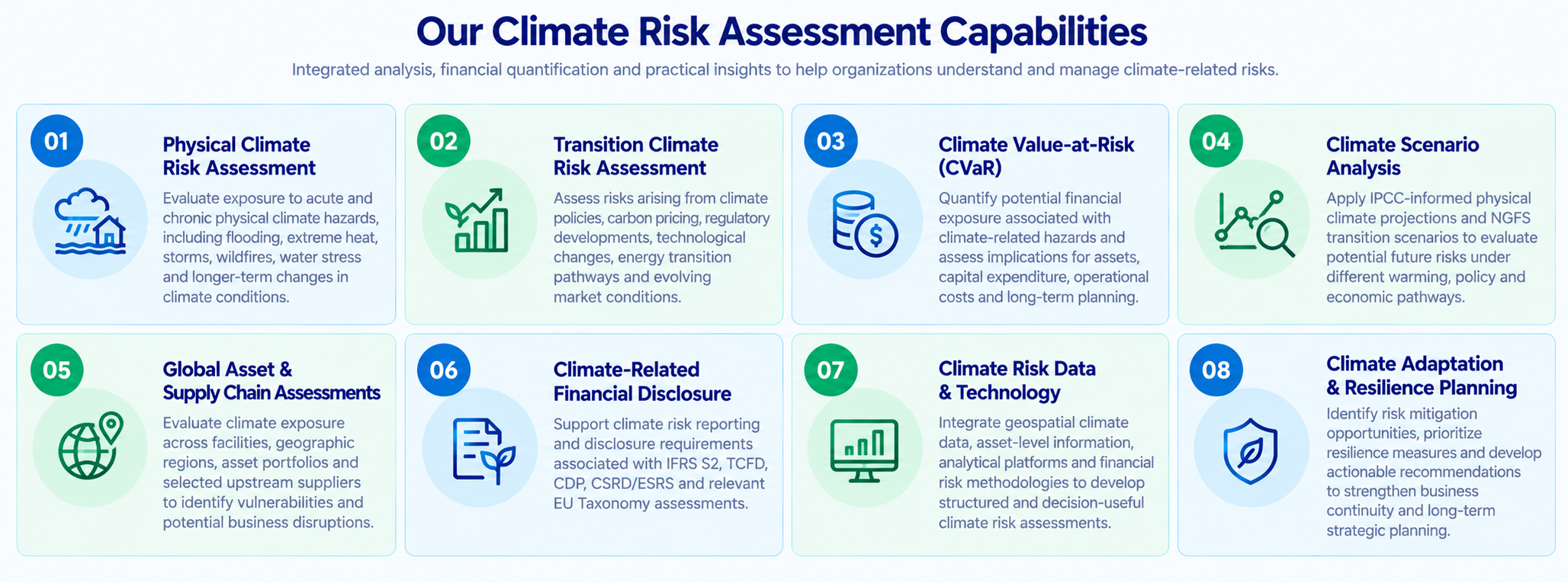
TBG’s climate risk capabilities.
Technology-Enabled Climate Risk Intelligence
Advanced Climate Modeling. Financial Risk Analysis. Actionable Insights.
TBG combines sustainability and risk management expertise with specialized climate data, modeling platforms and analytical technologies to deliver more comprehensive climate risk assessments.
Our technology-enabled approach helps organizations evaluate climate exposure across multiple facilities, regions and supply chains while translating complex scientific projections into information relevant to business decision-making.
Depending on project scope and analytical requirements, our approach can incorporate:
Geospatial climate intelligence: Location-based assessment of physical climate hazards.
Climate scenario modeling: Analysis of alternative warming and transition pathways.
Asset-level risk screening: Identification and prioritization of facilities exposed to material climate risks.
Financial impact modeling: Quantification of potential climate-related costs and financial exposure.
Portfolio-level analysis: Comparison of risks across multiple facilities and geographic regions.
Reporting integration: Development of outputs suitable for climate-related risk management and disclosure.
Resilience planning: Identification of potential adaptation measures and investment priorities.
Through our work with strategic partners, including ClimateRisk and ClimateFirst, TBG can connect specialized climate analytics with broader corporate sustainability, risk management and reporting needs.
Our objective is to help clients move from climate data to practical decisions—identifying where risks are concentrated, what the potential financial implications may be and how organizations can respond.Advanced Climate Modeling. Financial Risk Analysis. Actionable Insights.
Explore Our Climate Risk Assessment Solutions
Climate Risk FAQ
1. What is the difference between a climate risk assessment and a CVaR assessment?
A climate risk assessment identifies and evaluates potential physical and transition climate risks affecting an organization.
A Climate Value-at-Risk (CVaR) assessment goes further by quantifying specified climate-related impacts in financial terms.
The two approaches can be combined to help organizations understand both their exposure to climate risks and the potential economic consequences.
2. Can TBG assess climate risks across multiple countries and facilities?
Yes. TBG can support climate risk assessments across geographically dispersed facilities and operations, subject to the coverage and capabilities of the selected datasets and modeling tools.
Assessments can also incorporate relevant upstream supply-chain locations where sufficient location and operational information is available.
3. How far into the future can climate risks be assessed?
Climate assessments can cover short-, medium- and long-term horizons, depending on the objectives and selected models.
Certain climate scenario datasets provide projections extending to 2100. Financial impact assessments may use shorter horizons appropriate to asset lifetimes, investment decisions and the available financial models.
TBG helps clients select appropriate time horizons and interpret the resulting risks and uncertainties.
4. What information is needed for a climate risk assessment?
Typical information includes facility locations, asset characteristics, geographic exposure, operational activities, asset values, relevant supply-chain locations and available financial or insurance information.
Data requirements vary according to whether the assessment involves physical risk screening, transition risk analysis, CVaR modeling or a more comprehensive enterprise-level assessment.
5. Can climate risk assessments help with CDP and sustainability reporting?
Yes. Climate risk assessments can support disclosures relating to physical and transition risks, scenario analysis, potential financial impacts and climate risk management.
TBG can help organize assessment findings and align relevant information with CDP, IFRS S2, applicable European requirements and other reporting frameworks.
6. Can TBG combine climate risk modeling with insurance information?
Yes. Where suitable information is available, climate risk results can be evaluated alongside insurance coverage, historical loss information, property values and business interruption exposures.
This can help companies better understand potential financial vulnerabilities and inform insurance, capital planning and risk mitigation discussions.
7. How can companies use climate risk assessments to improve resilience?
Assessment findings can help companies identify higher-risk facilities, prioritize adaptation investments, evaluate business continuity measures and integrate climate considerations into long-term planning.
TBG can support the development of practical recommendations and implementation roadmaps based on the identified risks.
Why Work With TBG on Climate Risk Assessment?
Connecting Climate Science, Financial Analysis and Business Strategy.
TBG helps multinational companies and other organizations understand the implications of climate change for their assets, operations, supply chains and financial performance.
Our approach combines climate scenario analysis, financial risk assessment, sustainability reporting expertise and technology-enabled solutions to provide a comprehensive view of climate-related exposure.
We recognize that companies need more than a list of climate hazards. They need to understand which risks are material, how those risks may develop over time, what the potential financial consequences could be and how to prioritize appropriate responses.
Our capabilities include:
Integrated physical and transition risk analysis across multiple climate scenarios.
Financial quantification through CVaR and other applicable assessment methodologies.
Global assessment capabilities covering direct operations and relevant supply chains.
Advanced analytical technologies and access to specialized climate modeling expertise.
Reporting and regulatory alignment with applicable climate-related disclosure frameworks.
Actionable risk management recommendations supporting resilience and long-term planning.
Through our strategic relationships with specialized climate technology providers, including ClimateRisk and ClimateFirst, we connect advanced climate intelligence with practical corporate risk management and sustainability implementation.
Understand Your Climate Risk & Financial Exposure. Strengthen Supply Chain Resilience.
Whether your organization is conducting its first climate risk assessment, evaluating financial exposure through CVaR, assessing global facilities and supply chains or preparing climate-related disclosures, TBG can help.
Our team combines regulatory insight, climate analytics, financial risk assessment and technology-enabled solutions to support informed decision-making.