
SB 253 Compliance & Reporting: Requirements, deadlines and practical guidance for companies preparing for California's Climate Corporate Data Accountability Act.
What You Need to Know About SB 253
What is SB 253?
California Senate Bill 253 (SB 253), also known as the Climate Corporate Data Accountability Act, establishes greenhouse gas emissions reporting requirements for U.S.-organized business entities that do business in California and meet the applicable annual revenue threshold of more than $1 billion.
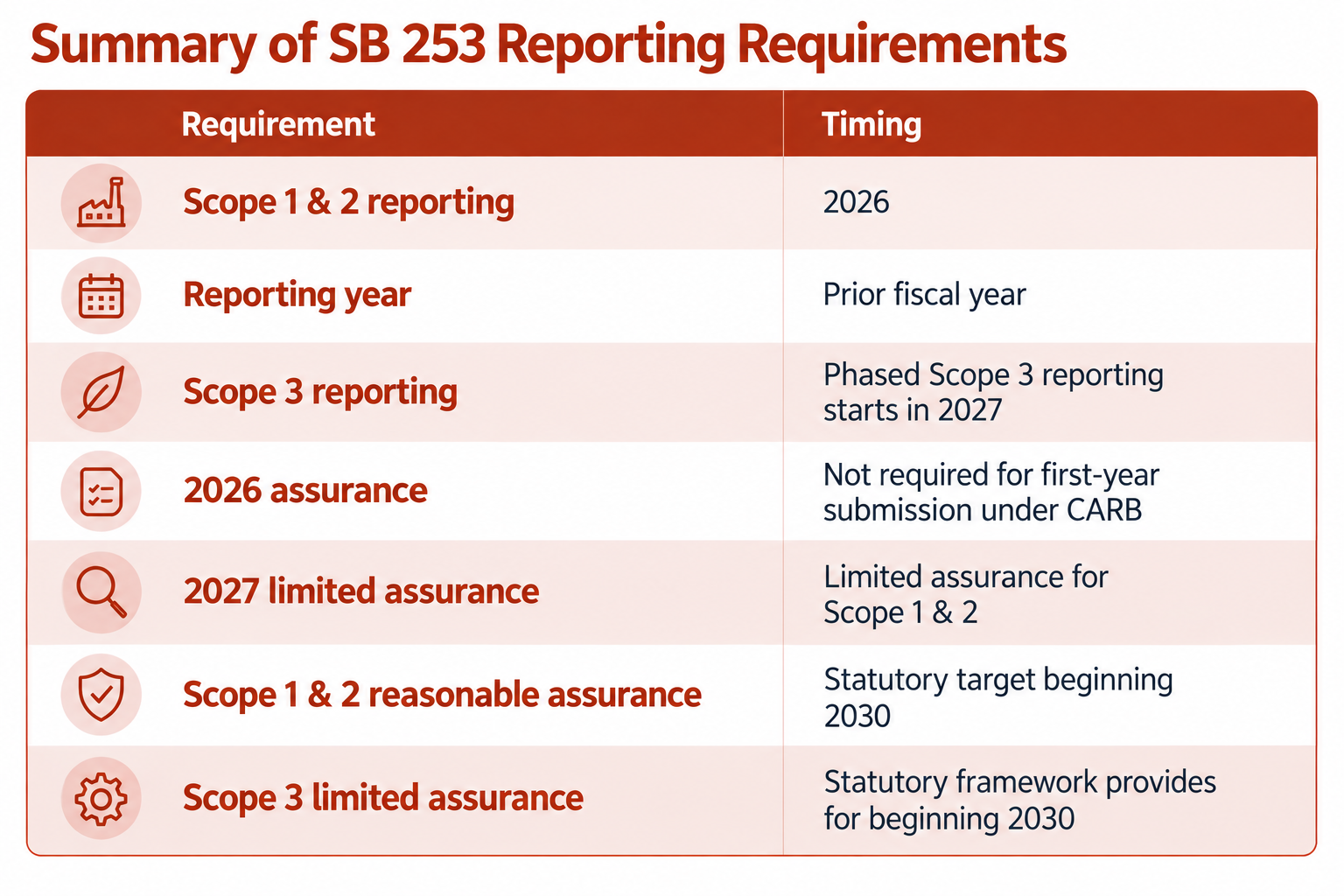
Covered companies must report their Scope 1 and Scope 2 greenhouse gas emissions beginning in 2026, with Scope 3 reporting beginning subsequently under the statutory and regulatory implementation schedule. The Bassiouni Group/TBG works closely with Fortune 1000 companies across the corporate sustainability spectrum. Click below to schedule a complimentary SB 253 Consultation.
Reporting Schedule
Not sure whether SB 253 applies to your company?
Review CARB's preliminary list of covered entities or schedule a complimentary consultation with TBG to discuss applicability and reporting readiness. Choose a convenient time slot via our Calendly or send an email.
What are the reporting/timing considerations and key requirements?
CARB officially postponed the deadline to November 10th, 2026, so you must take action now to accelerate or review your SB 253 compliance process. Companies are expected to report Scope 1 and Scope 2 emissions in 2026 (for the prior fiscal year) and Scope 3 emissions annually starting in 2027. For Scope 1 and Scope 2, limited assurance is expected in 2027, and "reasonable assurance" is expected by 2030. For Scope 3, limited assurance is required by 2030.
What guidance is available for SB reporting? What report format should we use?
CARB has published a Scope 1 and Scope 2 reporting template covering organization information, third-party verification, inventory boundaries, emissions disclosures, and calculation methodology. Use of the CARB template is voluntary for the 2026 reporting cycle.
Companies may instead use an existing GHG emissions report or another reporting format, as long as the submission satisfies applicable reporting requirements. TBG can review existing disclosures, identify gaps, and help prepare an SB 253-ready report.
What next steps should we take to ensure SB 253 compliance?
The November 10th deadline is fast approaching. Get in touch with TBG's sustainability team today – click below to send an email or pick a convenient meeting slot via our Calendly.
How TBG Can Support Your SB 253 Compliance Process
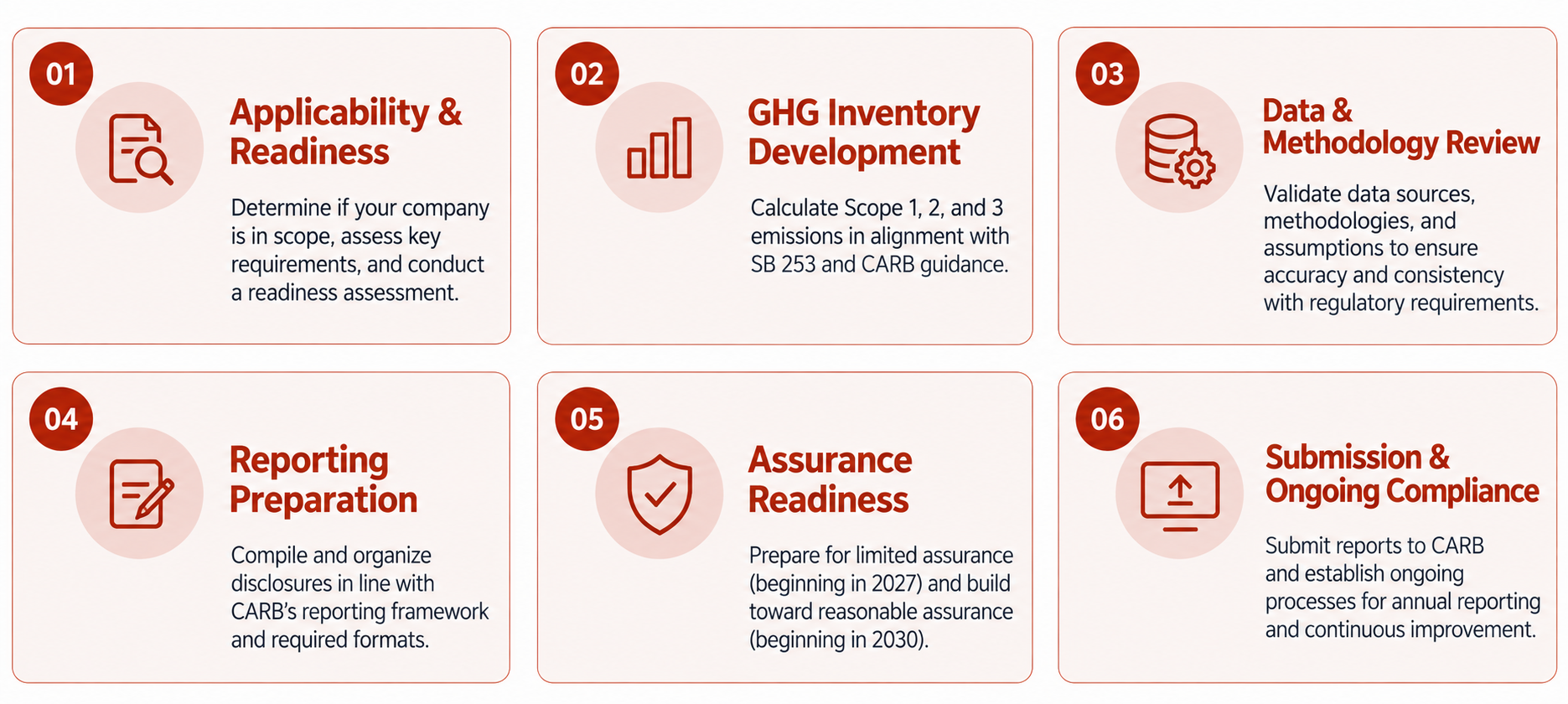
1. Applicability & Readiness Assessment
Confirm applicability, reporting boundaries, existing GHG inventories, data gaps, and assurance readiness.
2. GHG Inventory Development
Develop or review Scope 1 and Scope 2 inventories and prepare for Scope 3 requirements.
3. Data & Methodology Review
Review emissions factors, methodologies, organizational boundaries, source data, and documentation.
4. Reporting Preparation
Prepare SB 253-aligned disclosures using CARB's voluntary template or an appropriate existing reporting format.
5. Assurance Readiness
Review evidence, controls, methodologies, and documentation to prepare the emissions inventory for future third-party assurance requirements.
6. Submission & Ongoing Compliance
Support reporting, regulatory updates and the transition into subsequent annual reporting cycles
SB 253 FAQ
1.What is the SB 253 reporting deadline?
The deadline is November 10th, 2026. Online portal submissions via the CARB reporting platform close at midnight Pacific Time at the conclusion of the date.
2.Does SB 253 apply to companies headquartered outside California? Yes. SB 253 applies to U.S.-organized business entities that do business in California and meet the applicable annual revenue threshold of more than $1 billion.
3.What revenue counts toward the $1 billion SB 253 threshold? The $1 billion threshold is based on a company's total global annual revenue (global gross receipts), not just revenue generated in California.
4.Does SB 253 require Scope 3 emissions reporting? Yes. Scope 3 reporting begins in 2027 for the preceding fiscal year, following the initial Scope 1 and Scope 2 disclosures due in 2026.
5.Does SB 253 require third-party assurance? For Scope 1 and Scope 2, limited assurance is expected in 2027, and "reasonable assurance" is expected by 2030. For Scope 3, limited assurance is required by 2030.
6.Can we use our existing sustainability or GHG report? It depends. You can use or adapt your existing sustainability or GHG report if it meets the core requirements. We can review your current reports to determine whether they apply.
7.What happens if our company is not on CARB's preliminary list? If your company is not currently reflected in CARB's list and you meet the revenue and business thresholds, you will still need to comply with SB 253. We can review your company profile to determine whether SB 253 applies.
8.How does SB 253 differ from SB 261? SB 253 focuses on quantifying annual GHG emissions using the GHG Protocol and calls for precise measurement of direct and indirect (Scope 1, 2, 3) emissions. It applies to (public and private) companies with global annual revenues exceeding $1 billion doing business in California. In comparison, SB 261 requires biennial disclosures of climate-related financial risks that businesses face, aligned with the Task Force on Climate-related Financial Disclosures (TCFD) framework. SB 261 casts a broader net as it applies to companies with annual revenues exceeding $500m.
Why Work With TBG on SB 253
TBG's sustainability team works closely with Fortune 1000 companies, multinationals, global corporations, and SMEs/SMBs across the corporate sustainability spectrum. Our work ranges from reporting & disclosure activities and carbon accounting (organizational and product life-cycle assessments/LCAs) to U.S. and European regulations (SB 253, SB 54, SB 261 + EUDR, PPWR, CBAM, CSRD, CSDD) to climate risk assessments. We pride ourselves on taking a customized approach to each client and project and developing cost-effective solutions that are proven, measurable, and aligned with leading global frameworks and standards.
Why Companies Choose TBG
We understand that there are numerous sustainability consultants to choose from, and we encourage prospective clients to explore the competitive landscape. We are confident in our capabilities and track record with Fortune 1000 clientele. We do not provide “one-size-fits-all” services — we work closely with you at every step of your sustainability journey and deliver a customized solution.
SDG Roots & 2030 Agenda — As a company with a strong UN track record and UN roots, we have a deep understanding of the Sustainable Development Goals (SDGs). We are uniquely committed to the 2030 Agenda.
Global Team & Experience — Our sustainability team spans five continents. So, we can leverage both global and local knowledge. This core team is backed by TBG’s 1,000+ experts across 150+ countries and by TBG’s project management team.
Talent + Technology — We combine our human talent with the leading AI, data management, and supply chain analysis tools from leading technology partners to provide cutting-edge solutions.
Best Practices — TBG sits at the nexus of business, politics, and economics, and we work across the public and private sectors. So, we are uniquely positioned to implement "hybrid" best practices while remaining fully compliant with global reporting standards and frameworks.
Ethical Commitment — We hold ourselves to high professional and ethical standards and work with clients committed to credible, measurable progress on sustainability.
CSR Leaders — TBG co-founded CSR Leaders (on Linkedin) in 2012 to create a global community of sustainability professionals and encourage the sharing of knowledge and best practices. Today, the group includes over 34,000 professionals (executives/practitioners, students, supporters) worldwide, covering numerous industries and sectors.
Get SB 253 Support Now
Whether you're assessing applicability, reviewing an existing GHG inventory or preparing your first SB 253 disclosure, TBG can help you identify gaps and develop a practical path to compliance.