
With less than seven weeks remaining, companies must move beyond regulatory monitoring and put their EU Deforestation Regulation (EUDR) compliance systems into action. Here's what has changed, what's required and how The Bassiouni Group (TBG) can help.
The clock is ticking on one of the European Union's most consequential sustainability regulations. It’s time to schedule a Check-Up with our EUDR team. Book a meeting via our 👉 Calendly.
On December 30, 2026, the EU Deforestation Regulation (EUDR) becomes applicable to large and medium-sized operators and certain smaller operators covered by existing timber rules. After two postponements, multiple regulatory amendments and an extensive simplification process, companies now face a critical implementation deadline.
For businesses that manufacture, import, export or source products linked to the EU market, the challenge extends far beyond understanding the legislation. It requires mapping complex supply chains, engaging suppliers, collecting reliable data, assessing deforestation risks and establishing systems capable of supporting ongoing compliance.
The message for companies is clear: the time for preliminary planning and limited (“just enough) effort is running out. The focus must now shift to implementation.
What Is EUDR, and Which Companies Are Affected?
The EU Deforestation Regulation (Regulation (EU) 2023/1115) is designed to reduce the EU's contribution to global deforestation and forest degradation by ensuring that covered commodities and products entering or leaving the EU market meet specified environmental and legal requirements.
The regulation covers seven principal commodities:
Cattle
Cocoa
Coffee
Oil palm
Rubber
Soy
Wood
It also applies to certain derived products, including specified food products, rubber goods, wood products, furniture and paper-based materials, depending on their classifications under Annex I.
EUDR is not limited to European companies. U.S. and other international businesses with relevant products and EU supply-chain exposure may also be significantly affected, either through direct regulatory obligations or through information requests from customers and business partners.
For companies operating across multiple jurisdictions, determining which products, suppliers and transactions fall within scope is an essential first step.
December 30, 2026: The Key EUDR Deadline
Following the December 2025 legislative amendments and the European Commission's 2026 simplification review, the principal application dates are:
December 30, 2026 — Requirements begin applying to large and medium-sized operators and certain micro and small operators already covered by EU timber rules.
June 30, 2027 — Requirements begin applying to most other micro and small operators.
December 30, 2027 — Newly added products specified in the 2026 Delegated Act become subject to EUDR requirements.
While the regulation has been simplified, companies should not interpret these changes as a reason to delay preparation.
Supplier data collection, product classification, traceability and risk assessment can require substantial coordination across procurement, sustainability, compliance, legal and logistics functions.
Companies that have not yet established reliable systems may find the remaining implementation window particularly challenging.
What's Changed? The Latest EUDR Developments
The European Commission and EU legislators have introduced several important changes intended to streamline implementation and reduce unnecessary administrative burdens.
1. Simplified due diligence responsibilities
The revised framework concentrates Due Diligence Statement (DDS) submission obligations on operators first placing relevant products on the EU market or exporting them. Downstream operators and traders generally face reduced reporting requirements, although applicable traceability and recordkeeping obligations remain.
2. Revised product scope
The September 2026 Delegated Act updated the list of products covered by EUDR.
Certain cattle hides and leather products, retreaded tires, specified vulcanized rubber articles, soybeans for sowing and selected vehicle and aircraft seats were removed from scope.
Conversely, soluble coffee, frozen cattle tongues and certain palm oil derivatives were added, with a later application date of December 30, 2027.
These changes make it important for companies to revisit product classifications rather than relying on earlier EUDR assessments.
3. Reduced administrative requirements for smaller operators
Eligible micro and small primary operators can benefit from simplified declaration procedures, reducing some of the reporting complexity.
4. Improvements to the EUDR Information System
The European Commission has continued updating the digital infrastructure used for due diligence submissions, simplified declarations and data exchange.
These developments provide greater clarity for businesses, but they do not eliminate the need for reliable supplier information and functioning compliance processes.
Why EUDR Compliance Is More Than a Reporting Exercise
One of the most significant challenges associated with EUDR is that compliance depends on information often held outside a company's direct operations.
Businesses may need to gather and validate information from suppliers, manufacturers, agricultural producers and other participants across multiple tiers of the supply chain.
Depending on the product and applicable obligations, this may include:
Product classifications and covered commodity information
Supplier identities and countries of production
Geolocation data identifying relevant production plots
Evidence supporting deforestation-free and legally compliant sourcing
Risk assessments and supporting documentation
Mitigation measures where relevant risks are identified
Due diligence records and applicable submissions
The resulting challenge is both regulatory and operational.
Without reliable data, clear accountability and structured supplier engagement, companies may struggle to demonstrate compliance—even when their sourcing practices are otherwise responsible.
This is why EUDR readiness should be treated as a coordinated supply-chain and data-management initiative, not simply a sustainability reporting task.
Five Immediate Steps Companies Should Take
With the December deadline approaching, companies should prioritize the following actions.
1. Confirm applicability and product scope. Review relevant products, commodity inputs, Annex I classifications and the company's role in the EU supply chain. Reassess products affected by the 2026 amendments.
2. Identify critical suppliers and data gaps. Determine which suppliers and products require additional information, including traceability and geolocation data, and prioritize the most significant gaps.
3. Accelerate supplier engagement. Deploy standardized questionnaires, establish clear information requirements and engage suppliers directly to resolve missing or inconsistent data.
4. Establish due diligence and risk-management procedures. Develop documented processes for information verification, risk assessment, mitigation and recordkeeping, taking account of applicable country-risk classifications based on the EUDR country classification (benchmarking) list.
5. Prepare for reporting and ongoing monitoring. Ensure responsible teams understand the EUDR Information System, applicable submission requirements and the procedures needed to maintain compliance as products and suppliers change.
Companies that have already begun this process should conduct an immediate readiness review to identify unresolved issues before the deadline.
How TBG Helps Companies Navigate EUDR Compliance
At The Bassiouni Group (TBG), we work with global corporations and other businesses to translate complex sustainability regulations into practical compliance programs.
Our EUDR capabilities combine regulatory expertise, supplier engagement, data collection, risk assessment and technology-enabled compliance management.
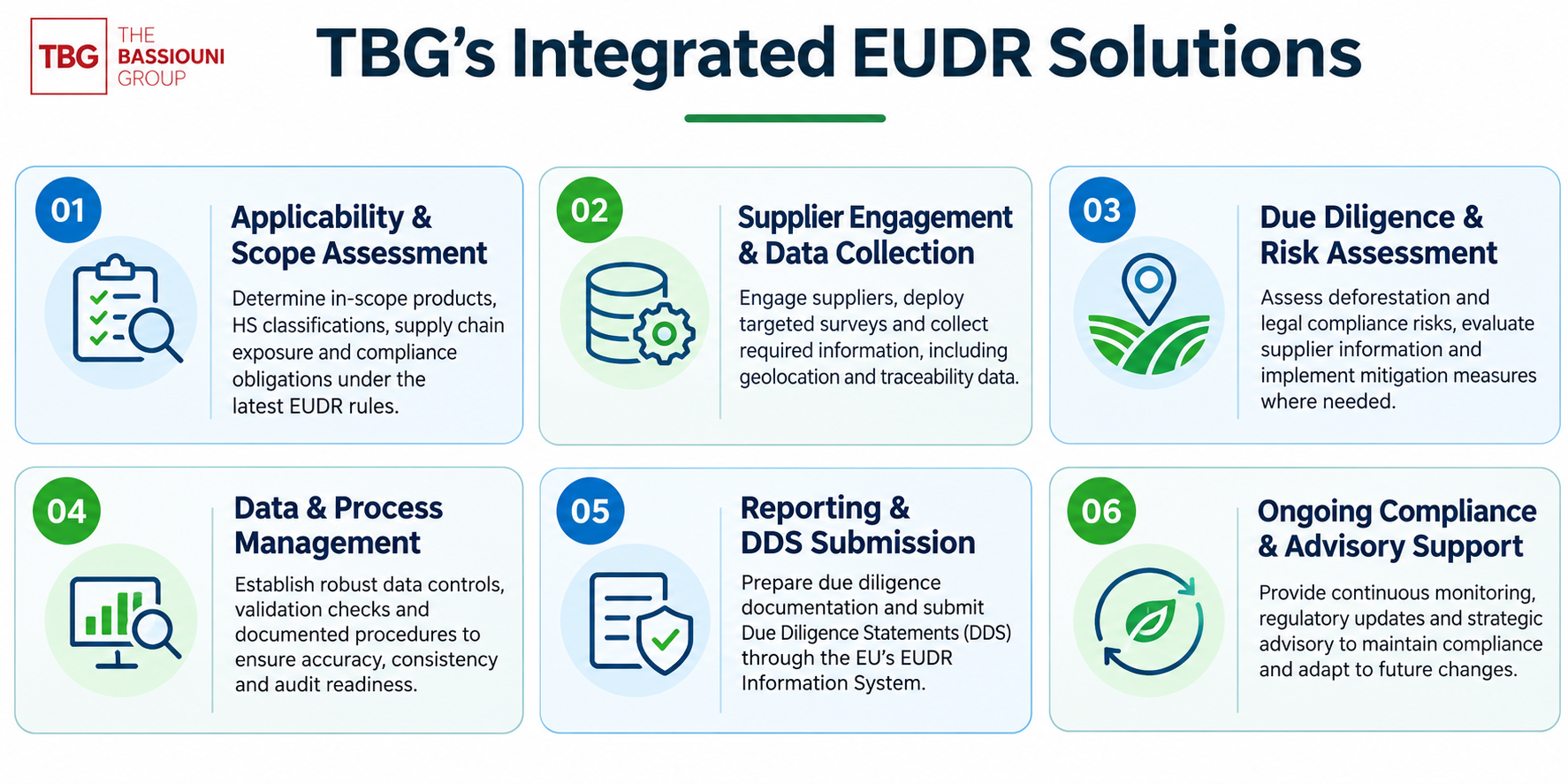
TBG supports clients throughout the implementation process, including:
EUDR applicability and readiness assessments: Determining relevant products, business activities, supply-chain exposure and compliance responsibilities.
Supplier engagement and training: Developing customized supplier surveys, coordinating information requests and delivering training for internal teams and external partners.
Data collection and traceability: Establishing structured processes to collect, organize and validate product, sourcing and geolocation information.
Risk assessment and mitigation: Identifying potential deforestation and regulatory risks, evaluating documentation gaps and developing appropriate mitigation measures.
Due diligence and reporting support: Preparing documentation, supporting applicable DDS requirements and developing repeatable compliance workflows.
Ongoing compliance management: Establishing monitoring, data-management and supplier engagement processes that support continued regulatory readiness.
Our experience supporting major multinational companies, including Fortune 1000 businesses, allows us to combine strategic guidance with hands-on implementation across complex operational and supply-chain environments.
Rather than relying on a one-size-fits-all approach, TBG develops customized solutions tailored to each client's products, suppliers, geographic exposure (geolocation) and existing information systems. We also develop tailored risk management systems and sourcing plans in coordination with internal teams (sustainability, compliance, legal, etc).
The Deadline Is Approaching. Is Your Company Ready?
The EUDR's latest amendments have provided additional clarity, but they have not removed the underlying need for robust due diligence and traceability.
With December 30 approaching, companies should be asking several critical questions:
Do we know which products are covered? Have we collected the necessary supplier information? Can we demonstrate traceability? Are our risk-management procedures and reporting systems ready?
For organizations still addressing these questions, the remaining weeks are an opportunity to identify gaps and take targeted action.
TBG can help.
Our sustainability and EUDR specialists can assess your current readiness, identify priority compliance gaps and develop a practical roadmap to meet applicable requirements.
Get EUDR Support Before the December 30 Deadline
Explore TBG's EUDR Compliance Solutions and schedule a complimentary consultation with our sustainability team.
👉 Learn More About TBG's EUDR Compliance Solutions
The Bassiouni Group | Corporate Sustainability, Regulatory Compliance & Climate Advisory