
Climate Week NYC 2026: Eight Key Takeaways for Corporate Sustainability Leaders
From Climate Ambition to Business Execution: What This Year's Discussions Mean for Global Companies
Climate Week NYC 2026 brought together corporate executives, policymakers, investors, climate experts, and civil society leaders for one of the world's largest annual gatherings focused on climate action. With more than 1,500 events and over 120,000 participants, the gathering provided a valuable opportunity to assess the direction of global climate policy, sustainable business practices, and the energy transition. Tellingly, the theme was “Energy. Impact. Action.”
But this year's Climate Week revealed something particularly important: corporate sustainability is entering a new phase, one increasingly defined by execution, economic competitiveness, resilience, and measurable business outcomes.
While ambitious emissions reduction targets and net-zero commitments remain important, discussions increasingly focused on the practical challenges of implementing climate strategies amid geopolitical uncertainty, rising energy demand, regulatory complexity, and growing physical climate risks.
For corporate sustainability leaders, this evolution presents both opportunities and challenges. Sustainability programs must increasingly demonstrate how they contribute to operational efficiency, financial resilience, supply-chain stability, and long-term enterprise value.
At The Bassiouni Group (TBG), we have identified eight key themes from Climate Week NYC 2026 that we believe will shape corporate sustainability strategies over the coming years. We support Fortune 1000 companies across the sustainability spectrum. Click on our Calendly to schedule a complimentary introductory call.
1. From Climate Ambition to Implementation: The Next Phase of Corporate Sustainability
One of the clearest messages emerging from Climate Week was that the corporate sustainability conversation is shifting from commitments toward implementation.
Over the past decade, thousands of companies have established emissions reduction targets, net-zero ambitions, and broader environmental commitments. While these announcements helped establish the foundations of corporate climate action, translating them into operational results has proven considerably more complicated.
Companies must now address the practical requirements of implementation, including:
Integrating climate considerations into corporate strategy and capital allocation.
Establishing reliable emissions inventories and environmental data systems.
Engaging suppliers and business partners across global value chains.
Developing measurable performance indicators and accountability mechanisms.
Balancing decarbonization objectives with financial and operational priorities.
The challenge is no longer simply determining what companies should commit to achieving, but how they can realistically deliver those commitments.
What this means for companies: Sustainability leaders should prioritize actionable implementation roadmaps, realistic milestones, cross-functional governance, and measurable outcomes. The credibility of corporate climate strategies will increasingly depend on demonstrated progress rather than the ambition of their stated targets.
2. Sustainability Is Becoming a Core Business Strategy
Another major theme was the increasing integration of sustainability with broader corporate business objectives.
Historically, sustainability programs were often managed as relatively independent environmental, social, and governance initiatives. Today, leading companies are increasingly connecting sustainability performance to financial outcomes, operational efficiency, market positioning, and enterprise risk management.
This reflects a fundamental evolution in how sustainability initiatives are evaluated.
Energy efficiency can reduce operating expenses. Climate risk assessments can inform investment decisions and insurance strategies. Supply-chain sustainability programs can strengthen supplier relationships and reduce operational vulnerabilities. Resource efficiency and circularity initiatives can improve material productivity and reduce waste.
Consequently, sustainability is increasingly being evaluated through the same commercial and financial lenses applied to other strategic business investments.
What this means for companies: Sustainability teams should strengthen their ability to quantify financial benefits, identify operational efficiencies, and demonstrate how environmental initiatives support long-term business competitiveness.
3. Energy Security and Geopolitics Are Reshaping the Energy Transition
Global energy security emerged as a particularly important theme during Climate Week 2026.
Geopolitical instability, energy-market disruptions, and volatility in fossil-fuel prices have reinforced the relationship between energy strategy, national security, and economic competitiveness.
Against this backdrop, renewable energy, electrification, energy storage, and energy efficiency are increasingly being evaluated not only for their emissions reduction benefits but also for their potential to improve energy security and reduce exposure to commodity-price volatility.
For energy-intensive sectors, including manufacturing, industrials, transportation, and technology, the implications are particularly significant.
Companies face the challenge of securing reliable, affordable energy while simultaneously managing emissions reduction commitments and growing demand for electricity.
The expansion of renewable generation, modernization of electricity grids, and development of energy storage infrastructure will therefore play increasingly important roles in corporate energy planning.
What this means for companies: Corporate energy strategies should evaluate decarbonization alongside energy reliability, cost exposure, geopolitical vulnerabilities, and long-term infrastructure requirements.
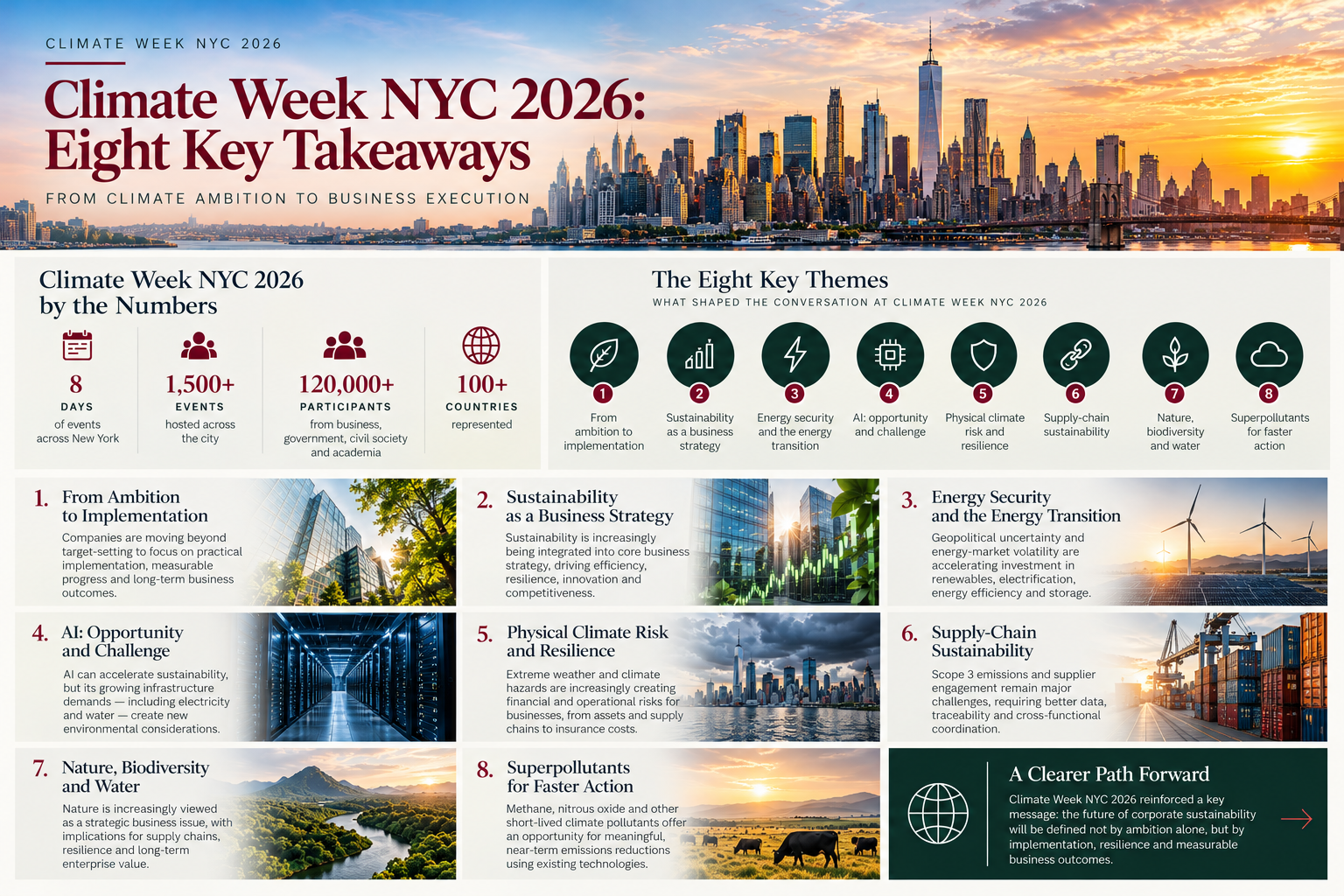
4. Artificial Intelligence: A Climate Solution and an Emerging Environmental Challenge
Artificial intelligence was among the most prominent topics discussed during Climate Week.
AI presents significant opportunities to accelerate environmental performance and improve the efficiency of complex industrial and commercial systems.
Potential applications include optimizing energy consumption, improving electricity grid management, forecasting climate hazards, enhancing supply-chain transparency, and supporting emissions measurement and reporting.
However, the rapid expansion of AI infrastructure also presents significant environmental challenges.
Data centers require substantial electricity, cooling infrastructure, and water resources. Their growing demand places additional pressure on electricity grids and raises important questions about energy sourcing, infrastructure investment, and local environmental impacts.
This creates an increasingly important strategic dilemma: how can businesses harness AI to accelerate sustainability performance while ensuring that AI adoption does not undermine environmental objectives?
What this means for companies: Organizations should assess both the sustainability benefits and environmental impacts of AI deployment. This includes evaluating energy demand, water consumption, technology procurement, data-center dependencies, and the potential of AI to improve operational efficiency.

5. Physical Climate Risk Is Becoming a Financial and Operational Priority
Climate adaptation and resilience received growing attention throughout Climate Week.
As extreme weather events and other climate-related hazards become more consequential for businesses, organizations are increasingly recognizing that physical climate risks can create material financial exposure.
Flooding, extreme heat, drought, wildfire, and severe storms can affect manufacturing facilities, transportation infrastructure, logistics networks, employees, suppliers, and customers.
These risks can also influence insurance costs, capital expenditure requirements, asset valuations, and business continuity planning.
Importantly, corporate climate risk management is evolving beyond identifying hazards toward quantifying their potential financial implications.
Companies are increasingly exploring how climate-related losses, asset vulnerabilities, and long-term risk scenarios can be incorporated into financial planning and strategic decision-making.
What this means for companies: Physical climate risk assessments should move beyond qualitative risk identification toward financial quantification, including potential asset damage, business interruption, insurance implications, and climate value-at-risk analysis.
6. Supply-Chain Sustainability Remains One of the Greatest Implementation Challenges
Despite advances in corporate sustainability reporting and emissions accounting, global supply chains remain a major source of complexity.
For many companies, a substantial portion of their environmental footprint exists outside their direct operations, particularly through purchased goods and services, transportation, product use, and end-of-life activities.
This makes Scope 3 emissions measurement and supplier engagement especially challenging.
Companies must often work across extensive networks of suppliers operating in different jurisdictions, with varying levels of environmental data availability, regulatory exposure, and sustainability maturity.
At the same time, evolving regulatory requirements are increasing expectations around supply-chain transparency, product-level information, packaging, and environmental due diligence.
For multinational companies, regulations such as the EU Deforestation Regulation (EUDR), the EU Packaging and Packaging Waste Regulation (PPWR), and emerging extended producer responsibility requirements are adding new dimensions to supply-chain management.
What this means for companies: Businesses should prioritize supplier segmentation, environmental data quality, traceability, and stronger coordination between procurement, sustainability, legal, and operational teams. Integrated data systems will become increasingly valuable as reporting and compliance requirements expand.

7. Nature, Biodiversity, and Water Are Emerging as Strategic Business Risks
Nature-related risks received significant attention during Climate Week, reflecting growing recognition of the relationship between ecosystem health and economic activity.
Businesses depend on natural resources and ecosystem services in numerous ways, including water availability, agricultural production, raw material sourcing, and climate regulation.
Environmental degradation can therefore create operational vulnerabilities and financial exposure, particularly for companies operating in resource-intensive sectors or sourcing materials from environmentally sensitive regions.
The emerging corporate conversation increasingly focuses on understanding dependencies on nature, identifying environmental impacts, and assessing how ecosystem changes could affect long-term business performance.
Frameworks such as the Taskforce on Nature-related Financial Disclosures (TNFD) are helping organizations structure their assessments of nature-related dependencies, impacts, risks, and opportunities.
What this means for companies: Sustainability strategies should progressively integrate biodiversity, water, and nature-related risk assessments, particularly where operations or supply chains depend on sensitive ecosystems or natural resources.
8. Superpollutants: An Opportunity for Faster Climate Action
One of the more noteworthy developments surrounding Climate Week was increased attention to superpollutants—powerful climate pollutants that can have a disproportionate effect on global warming.
These include methane, nitrous oxide, black carbon, and certain refrigerant gases.
While carbon dioxide remains central to long-term climate mitigation, reducing many superpollutant emissions can generate significant near-term benefits.
Importantly, technologies and operational practices capable of reducing these emissions are already available across several sectors.
Examples include methane leak detection and repair, improved waste management, more efficient agricultural practices, and transitioning away from high-global-warming-potential refrigerants.
The growing attention to superpollutants reflects a broader interest in identifying practical emissions reduction opportunities that can deliver measurable results within shorter timeframes.
What this means for companies: Organizations should assess whether superpollutants represent a material component of their direct operations or value chains and identify technically feasible, cost-effective opportunities for reduction.
Five Strategic Priorities for Corporate Sustainability Leaders
Taken together, these eight themes suggest that the next phase of corporate sustainability will require greater integration between environmental objectives and core business decision-making.
We believe companies should prioritize five areas:
1. Integrate sustainability into enterprise strategy. Connect environmental objectives with financial planning, operational performance, capital allocation, and business resilience.
2. Strengthen climate risk assessment capabilities. Quantify physical and transition risks, evaluate potential financial exposure, and incorporate findings into strategic decision-making.
3. Improve sustainability data and reporting systems. Establish reliable data collection, verification, and governance processes that can support evolving regulatory requirements and stakeholder expectations.
4. Accelerate supply-chain engagement. Prioritize high-impact suppliers, improve environmental data transparency, and integrate sustainability considerations into procurement and sourcing decisions.
5. Focus on measurable implementation. Translate climate and sustainability commitments into achievable milestones, operational improvements, and clearly defined performance indicators.
Conclusion: Corporate Sustainability Is Entering Its Execution Era
Climate Week NYC 2026 reinforced a central message: the business case for sustainability is increasingly being defined by implementation, resilience, and measurable results.
The next generation of corporate sustainability leaders will need to navigate a complex landscape of environmental risks, energy-market changes, technological innovation, evolving regulations, and shifting stakeholder expectations.
Success will depend not simply on setting ambitious environmental objectives, but on developing the organizational capabilities, data systems, governance structures, and operational strategies necessary to achieve them.
For global companies, this presents an opportunity to reposition sustainability as an integral component of long-term competitiveness and enterprise value creation.
The question is no longer simply whether sustainability matters to business. It is how effectively companies can translate sustainability strategy into business performance.
How The Bassiouni Group Can Help
At The Bassiouni Group, we work with multinational companies to navigate complex sustainability challenges and translate environmental objectives into practical business solutions.
Our capabilities include:
Climate Risk Assessment: Physical and transition risk analysis, scenario modeling, and financial impact assessment.
Carbon Accounting and Reporting: Scope 1, 2, and 3 emissions inventories, reporting frameworks, and disclosure readiness.
Regulatory Compliance: Support for evolving requirements including California's SB 253 and SB 54, the EU PPWR, and EUDR.
Supply-Chain Sustainability: Supplier engagement, environmental data management, traceability, and compliance readiness.
Corporate Sustainability Strategy: Sustainability program development, performance assessment, and implementation support.
Whether your organization is strengthening its climate risk management capabilities, preparing for new regulations, or seeking to integrate sustainability more effectively into business operations, our team can help.
Schedule a 30-minute consultation with The Bassiouni Group — CLICK HERE — to discuss your sustainability priorities and the practical steps your organization can take.
Learn more at TBG Sustainability and/or visit select services pages such as Carbon Accounting or EUDR or SB 253/California.
Further Resources
Climate Group — Climate Week NYC 2026 Official Report — participation figures, announcements, and event outcomes.
PwC — Climate Week 2026 Key Takeaways — sustainability's relationship with business growth, infrastructure, and financial value.
ERM — Climate Week NYC 2026 Summary — implementation challenges, energy, AI, and climate adaptation.
WWF — From Ambition to Action — nature, water, resilience, and corporate climate strategy.
Reuters — The World Is Overlooking a Powerful Brake on Global Warming — superpollutants and near-term climate mitigation.