
UNDP Launches a New Africa Digital Accelerator
During the United Nations (UN) Open Source Week 2026 in New York, the United Nations Development Programme (UNDP) launched the Africa Accelerator for Digital Public Infrastructure (AA4DPI), a new initiative designed to help African countries build sovereign, scalable and inclusive digital public infrastructure (DPI). Jointly led by UNDP's Regional Bureau for Africa and the organization's Digital, AI and Innovation Hub, the Accelerator seeks to support countries as they move beyond fragmented digital projects toward interoperable systems that can underpin public service delivery across sectors.
The launch of the AA4DPI initiative reflects a broader shift in how African governments are approaching digital development. While global debates are focusing on expanding digital infrastructure and deploying artificial intelligence (AI), the long-term developmental impact of these technologies will depend less on technological adoption itself than on who governs digital systems, controls the underlying data, and develops the institutional capacity to maintain them. In this sense, AA4DPI is not simply another technology initiative, it represents an emerging debate over digital sovereignty in Africa and raises questions about how African states intend to position themselves in an increasingly AI-driven global economy.
Digital Public Infrastructure (DPI) refers to interoperable digital systems that provide foundational public functions, typically organized around three layers: digital identity, digital payments, and secure data exchange. Governments across the world increasingly rely on these systems to deliver public services, improve state capacity, and foster economic inclusion. Yet as generative AI technologies become more deeply embedded in governance and service delivery, DPI is acquiring additional strategic significance. AI systems depend on large volumes of high-quality data, interoperable digital architectures, and institutional capabilities capable of governing increasingly complex socio-technical systems. Consequently, countries that build and govern DPI effectively could also be better positioned to participate in and benefit from the AI economy.
Africa has experienced rapid growth in DPI initiatives over the past decade. According to the Digital Public Infrastructure Map, dozens of national initiatives are currently underway across the continent, particularly in digital identity and payment systems. Countries such as Algeria, Rwanda, Kenya, Nigeria, Ghana, and South Africa have emerged as important laboratories for digital state-building. But across the African Union's 55 member states, adoption of DPI-like systems still remains uneven. The UNDP shows that digital identity is the least developed of the three pillars, operational in just six countries. Digital payments are somewhat further along, active in eight countries, though none are currently at the pilot stage. Data exchange systems are the most widely adopted, running in 17 countries and piloted in nine. Even so, no country has all three pillars fully operational, and only eight have two of the three active, underscoring how early-stage the continent's DPI ecosystem still is.
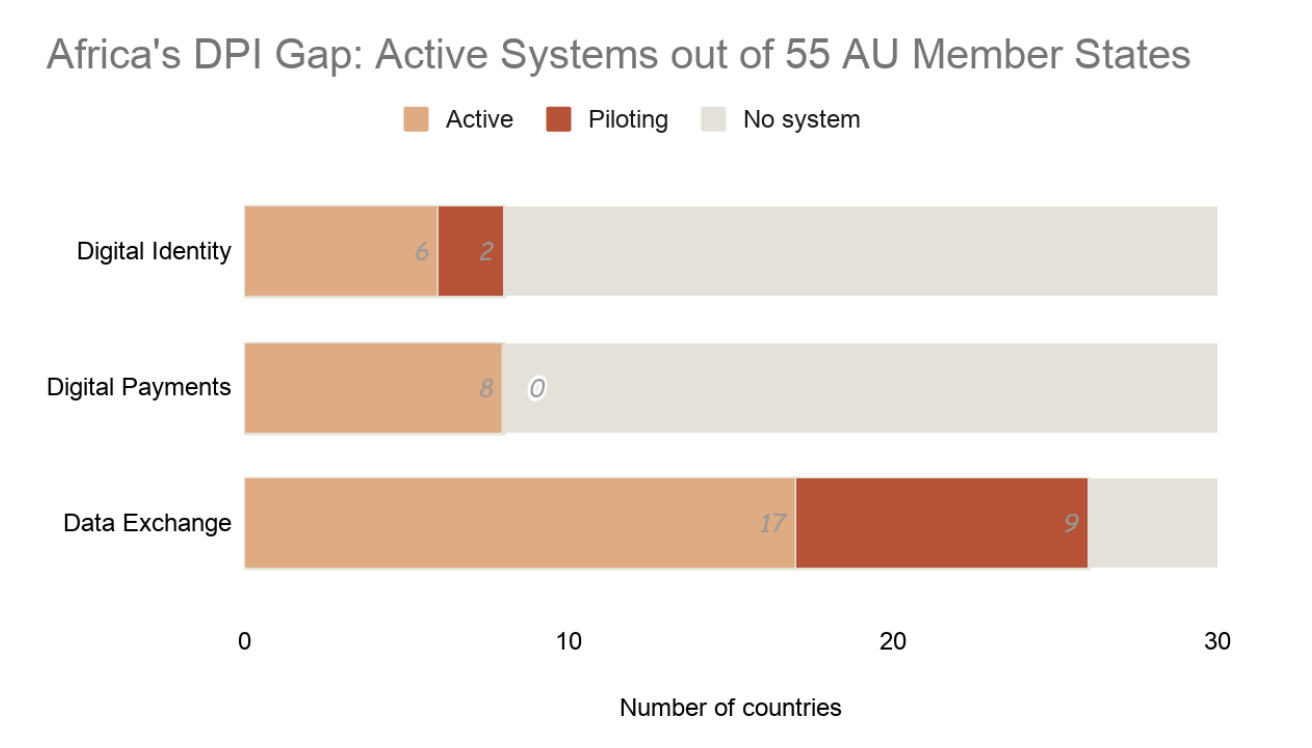
Sources: Created by this author with data from UCL Institute for Innovation and Public Purpose, DPI Map (2026 Q1 dataset) · UNDP Africa DPI Full Report (2026) for three-pillar figures. "Full DPI" = meets UCL IPP threshold criteria (Count for DPI = 1). Digital identity pillar only shown at country level; payments and data exchange country-level data held in separate dataset tabs.
As mentioned earlier, this process of DPI expansion also raises concerns regarding dependence on external actors. Much of the digital infrastructure deployed in developing countries continues to rely heavily on foreign vendors, external technical expertise, and proprietary technologies. Such dependencies may create vulnerabilities that extend beyond technology procurement and affect states’ ability to govern their own digital futures. UNDP has explicitly framed AA4DPI as an initiative to support "sovereign, scalable and inclusive" digital public infrastructure. The concept of digital sovereignty is therefore central to understanding the significance of AA4DPI.
Digital sovereignty is not only about owning digital systems, it encompasses four main aspects: control over code and technical architecture; governance and stewardship of public data; domestic capacity to maintain, adapt, and secure systems; and reduced dependence on external providers for critical digital services. As it is seen with DPI expansion in Africa, countries may achieve progress in one dimension while remaining dependent in others.
The initiative mentions open-source as one possible tool to help promote digital sovereignty in the continent. Open-source systems can reduce costs, improve interoperability, and allow governments greater flexibility to adapt technologies to local contexts. Equally important, they may facilitate knowledge transfer and support the development of local innovation ecosystems. Nevertheless, open-source adoption alone cannot guarantee digital sovereignty. Without domestic technical expertise, sustainable financing, and strong public institutions, countries will remain dependent on external actors for implementation, maintenance, and cybersecurity.
These concerns have naturally been mentioned by African policymakers. In fact, the African Union talked, in the context of the negotiations of the UN Global Digital Compact, about the importance of digital sovereignty, local capacity-building, data governance, equitable participation in digital economies, and the development of domestic technological ecosystems. The document also highlighted concerns regarding persistent digital inequalities and asymmetries in global technology governance. Viewed through this lens, AA4DPI can be interpreted as an attempt to respond to priorities that African governments have already identified collectively.
Finally, the political economy of digital development in Africa also invites comparison with another strategic sector: critical minerals. African countries possess about 30% of the world’s critical mineral reserves, some of them essential for the global energy transition, yet historically much of the value generated from resource extraction has increased in other parts of the world. A similar pattern could emerge in digital development if African countries become primarily providers of data and consumers of imported technologies while higher-value activities (including AI model development, platform ownership, and advanced digital services, etc.) remain abroad. AA4DPI could therefore represent an effort to avoid reproducing historical dependency patterns in the digital era.
Creating resource wealth without local value capture is unfortunately not new in Africa. The AA4DPI initiative is looking to avoid this to promote that African governments end up owning the value their own data generates so they have full digital sovereignty. But it cannot supply the budget, the technical staff, the institutional strength, or the political patience needed to actually use the guidelines provided by the AA4DPI, so it will also be up to policymakers, investors, civil society and citizens to make sure this is used wisely.